Test Index
Differential Equations
Differential Equations

 CBSE Board Videos
© examsnet.com
Question : 13 of 34
Marks:
+1,
-0
Case Study – 2A bacteria sample of certain number of bacteria is observed to grow exponentially in a given amount of time. Using exponential growth model, the rate of growth of this sample of bacteria is calculated.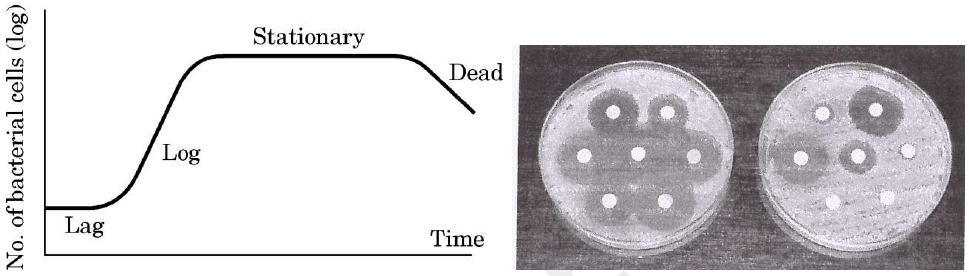 The differential equation representing the growth of bacteria is given as :, where P is the population of bacteria at any time 't'.Based on the above information, answer the following questions :(i) Obtain the general solution of the given differential equation and express it as an exponential function of 't'. (2)(ii) If population of bacteria is at , and at , find the value of k. (2)
[CBSE 2024 65/3/1]
Solution:
(i). Separating the variables:Integrating: Result: , where is an arbitrary positive constant (P is a population, so ).(ii)At , : , so .At , : Result: ()
© examsnet.com
Go to Question: