Test Index
Application of Derivatives
Application of Derivatives

 CBSE Board Videos
© examsnet.com
Question : 32 of 45
Marks:
+1,
-0
Case Study - 1A tank, as shown in the figure below, formed using a combination of a cylinder and a cone, offers better drainage as compared to a flat bottomed tank.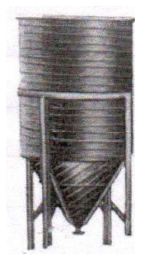 A tap is connected to such a tank whose conical part is full of water. Water is dripping out from a tap at the bottom at the uniform rate of . The semi-vertical angle of the conical tank is .On the basis of given information, answer the following questions :(i) Find the volume of water in the tank in terms of its radius r. (1)(ii) Find rate of change of radius at an instant when cm. (1)(iii) (a) Find the rate at which the wet surface of the conical tank is decreasing at an instant when radius cm. (2)OR(iii) (b) Find the rate of change of height 'h' at an instant when slant height is 4 cm. (2)
[CBSE 2023 65/1/3]
Solution:
Let the water in the conical part have radius , height and slant height at time . Semi-vertical angle gives , so and .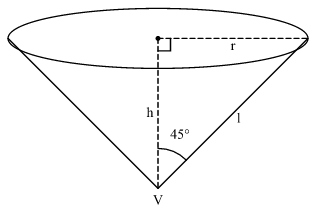 Water drips out at : .(i) (as )(ii)At : The radius is decreasing at cm/s.(iii)(a)Wet surface = curved surface of the water cone: At : The wet surface is decreasing at .OR (iii)(b); when : cm (and ).The height is decreasing at cm/s.
© examsnet.com
Go to Question: