Test Index
Application of Derivatives
Application of Derivatives

 CBSE Board Videos
© examsnet.com
Question : 3 of 45
Marks:
+1,
-0
Case Study – 1At a birthday party, children are being served orange juice in conical cups, as shown in the figure.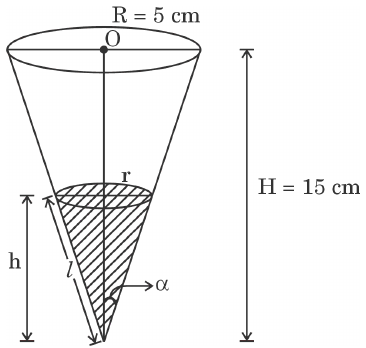 Each cup is 15 cm deep and has a radius 5 cm. The juice is being poured into this cup at a rate of .On the basis of the above information, answer the following questions :(i) Establish a relation between the height h of the juice in the cup and radius r of the surface of the juice in the cup, if the semi-vertical angle of the cone is . (1)(ii) At what rate is the juice level in the cup rising when the juice is 6 cm deep ? (1)(iii) (a) When the juice is 6 cm deep, then find at what rate is the upper surface area of juice increasing ? (2)OR(iii) (b) When the juice is 6 cm deep, then find the rate at which the wetted surface area of the cup is increasing. (2)
[CBSE 2026 65/4/1]
Solution: 👈: Video Solution
(i)The juice forms a smaller cone with the same semi-vertical angle as the cup.In the right triangle formed by the axis, the radius and the slant side: .For the full cup, .Result: , i.e. (ii)Volume of juice: At cm, : Result: (iii)(a)Upper surface of the juice is a circle of radius :At : Result: The upper surface area increases at OR (iii)(b)The wetted surface is the curved surface of the juice cone: , where .With : At : Result: The wetted surface area increases at (about )Key point: First express everything in terms of alone using , then differentiate with respect to (chain rule).
© examsnet.com
Go to Question: