Test Index
Application of Derivatives
Application of Derivatives

 CBSE Board Videos
© examsnet.com
Question : 24 of 45
Marks:
+1,
-0
Case Study – 3Overspeeding increases fuel consumption and decreases fuel economy as a result of tyre rolling friction and air resistance. While vehicles reach optimal fuel economy at different speeds, fuel mileage usually decreases rapidly at speeds above 80 km/h.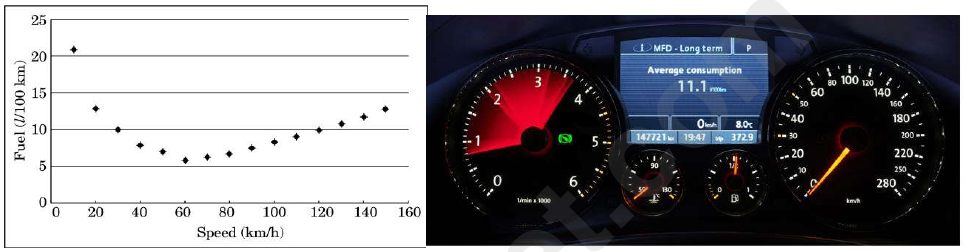 The relation between fuel consumption F (/100 km) and speed V (km/h) under some constraints is given as .On the basis of the above information, answer the following questions :(i) Find F, when V = 40 km/h. (1)(ii) Find . (1)(iii) (a) Find the speed V for which fuel consumption F is minimum. (2)OR(iii) (b) Find the quantity of fuel required to travel 600 km at the speed V at which . (2)
[CBSE 2024 65/2/2]
Solution:
Given: (i): Result: /100 km(ii)Result: (iii)(a), so F is minimum at this speed.Result: km/hOR (iii)(b) km/hAt : /100 kmFuel for km Result: litres
© examsnet.com
Go to Question: