Test Index
Reading Comprehension (Class 12)
Reading Comprehension (Class 12)

 CBSE Board Videos
© examsnet.com
Question : 26 of 49
Marks:
+1,
-0
Read the passage given below : (6 marks)1. Our history makes it evident that the Indian Plastics Industry made a vigorous beginning in 1957 but it took more than 30 years for it to pervade Indian lifestyles. In 1979, ‘the market for plastics’ was just being seeded by the State-owned Indian Petrochemicals and it was only in 1994 that plastic soft drink bottles became a visible source of annoyance.2. In the same year, people in other cities were concerned about the state of public sanitation and also urged regulatory bodies to ban the production, distribution and use of plastic bags. However, the challenge was greater than it appeared at first.3. The massive generation of plastic waste in India is due to rapid urbanisation, spread of retail chains, plastic packaging from grocery to food and vegetable products, to consumer items and cosmetics. The projected high growth rates of GDP and continuing rapid urbanisation suggests that India’s trajectory of plastic consumption and plastic waste is likely to increase.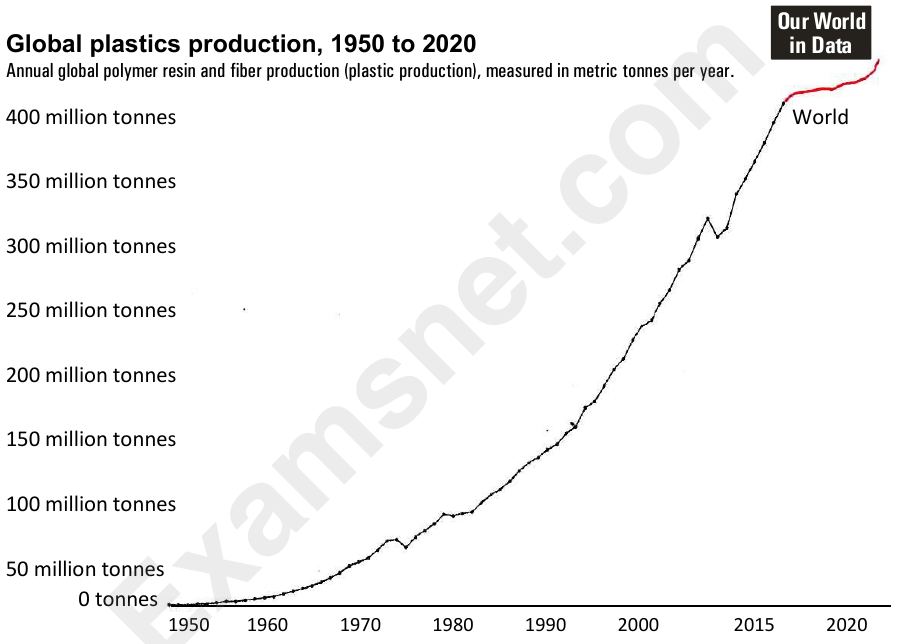 4. According to the United Nations Environment Programme (UNEP) Report of 2018, India stands among few other countries like France, Mongolia and several African countries that have initiated total or partial national level bans on plastics in their jurisdictions. On World Environment Day in 2018, India vowed to phase out single-use plastics by 2022, which gave a much needed impetus to bring this change.5. In this context, thereafter, ten States (Andhra Pradesh, Chhattisgarh, Gujarat, Himachal Pradesh, Karnataka, Madhya Pradesh, Meghalaya, Odisha, Rajasthan and Tamil Nadu) are currently sending their collected waste to cement plants for co-processing. Twelve other States/UTs are using plastic waste for polymer bitumen road construction and still four other States are using the plastic waste for waste-to-energy plants and oil production. A world of greater possibilities has now opened up to initiate appropriate and concrete actions to build up the necessary institutions and systems before oceans turn, irreversibly, into a thin soup of plastic.6. However, there is no one single masterstroke to counter the challenges witnessed by the staggering plastic waste management in the country. The time is now to formulate robust and inclusive National Action Plans, and while doing so, the country will establish greater transparency to combat the plastic jeopardy in a more sustainable and holistic way.Based on your understanding of the passage, answer any six out of the seven questions given below : (6×1=6)(i) What does the writer mean by ‘visible source of annoyance’ ? (1)(ii) Why did people demand a ban on plastics ? (1)(iii) What created a demand for plastics in India ? (1)(iv) What does the line, ‘oceans turn, irreversibly into a thin soup of plastic’, suggest ? (1)(v) What step can be taken to combat the challenges of plastic waste management ? What will be its impact ? (1)(vi) With reference to the graph, write one conclusion that can be drawn about the production of plastics in 2019 (approximately). (1)(vii) What does the upward trend of the graph indicate ? (1)
[CBSE 2022 1/2/3]
Solution:
(i) It means something that irritates people because it is seen everywhere — an eyesore. By 1994, plastic soft drink bottles were lying around everywhere and spoiling the surroundings.(ii) People were worried about the poor state of public sanitation caused by plastic waste, so they urged regulatory bodies to ban the production, distribution and use of plastic bags.(iii) Rapid urbanisation, the spread of retail chains and the use of plastic packaging for groceries, food, vegetables, consumer items and cosmetics.(iv) It suggests that if plastic waste is not managed now, the oceans will be so filled with plastic that the damage can never be undone.(v) Step: India must formulate robust and inclusive National Action Plans.Impact: They will bring greater transparency and help fight the plastic problem in a more sustainable and holistic way.(vi) In 2019, global plastic production was more than 400 million tonnes a year, and the rise had slowed down — the curve is almost flat around that year.(vii) The upward trend shows a huge, steady increase in global plastic production from 1950 to 2020, and suggests that production will keep rising.
© examsnet.com
Go to Question: