Test Index
Reading Comprehension (Class 12)
Reading Comprehension (Class 12)

 CBSE Board Videos
© examsnet.com
Question : 20 of 49
Marks:
+1,
-0
Read the passage given below :1. Fast-Moving Consumer Goods (FMCG) are products that sell quickly at relatively low cost. FMCG is the fourth-largest sector in the Indian economy. There are three main segments in the sector — food and beverages, which accounts for 19% of the sector; healthcare, which accounts for 31% of the share; and household and personal care, which accounts for the remaining 50% share. The urban segment contributes to about 55% of the revenue share, while the rural segment accounts for 45%. Rise in rural consumption will drive the FMCG market. The Indian processed food market is projected to expand to USD 470 billion by 2025, up from USD 263 billion in 2019 – 20.2. The Indian FMCG industry grew by 16% in 2021, a 9-year high, despite nationwide lockdowns, supported by consumption-led growth and value expansion from higher product prices, particularly for staples. Real household spending is projected to increase 9.1% after 2021, after a decrease of 9.3% in 2020 due to the economic impact of the pandemic. Price increase across product categories will offset the impact of rising raw material prices, along with volume growth and resurgence of demand for discretionary items.3. The FMCG sector has received good investments and support from the Government in the recent past. The sector witnessed healthy FDI inflows from April 2000 – March 2022. Furthermore, as per the Union Budget 2022 – 23, a substantial amount has been allocated to the Department of Consumer Affairs, an increased amount has been allocated to the Department of Food and Public Distribution. In 2021 – 22, the Government approved Production-Linked Incentive Scheme for Food Processing Industry (PLISFPI) with an outlay of a larger amount to help Indian brands of food products in the international markets.4. The Government’s Production-Linked Incentive (PLI) Scheme gives companies a major opportunity to boost exports. The future outlook of the FMCG rural sector looks on track now. Rural consumption has increased, led by a combination of increasing income and higher aspiration levels. There is an increased demand for branded products in rural India. The growth of organised sector in FMCG is expected to rise with an increased level of brand consciousness, augmented by the growth in modern retail.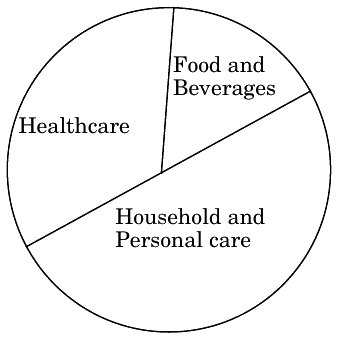
Based on your understanding of the passage, answer the questions given below : (10 × 1 = 10)(i) Does the following statement agree with the information given in para 1 ?Food and beverages segment dominates the Global FMCG market and is expected to retain its dominance.Select from the following :I. True – If the statement agrees with the informationII. False – If the statement contradicts the informationIII. Not Given – If there is no information on this(ii) What do you think gives opportunities to boost exports ?(iii) Select the option that displays the most likely reason for FMCG rural sector being on track.(a) FMCG sector has been unable to get investments from the Government.(b) PLI schemes don’t reach the rural sector.(c) Gross Merchandise Value (GMV) of the online grocery segment in India is expected to double in the next five years.(d) There is a desire to buy branded products in the villages too.(iv) Complete the sentence based on the following statement :The Indian FMCG industry grew by 16% in 2021, a 9-year high, despite nationwide lockdowns because __________.(v) From the given pie chart, which segment of FMCG accounts for the maximum percentage of the sector ?(vi) Complete the given sentence by selecting the most appropriate option :The combination of increasing income and higher aspiration levels in the rural areas has led to __________.(a) the Government taking a direct interest(b) the demand for branded products(c) price increases across product categories(d) the fall of supply in urban areas(vii) How is the Government trying to help Indian brands of food products in the international markets ?(viii) Complete the given sentence by selecting the most appropriate option :The concluding paragraph of the passage makes a clear case __________.(a) that the rural people also want branded products(b) that the FMCG industry will not focus on brand consciousness(c) for the role of data analytics in the FMCG industry(d) for the Government’s role by providing incentives(ix) What will be the impact of increased level of brand consciousness ?(x) Based on the reading of the passage, correct the following statement :The urban segment contributes to about 45% of the revenue share, while the rural segment accounts for 55%.
| Table I. FMCG Products |
| 1. Processed foods : Cheese products, cereals |
| 2. Prepared meals : Ready-to-eat meals |
| 3. Beverages : Bottled water, aerated drinks, and juices |
| 4. Baked goods : Biscuits, bread |
| 5. Fresh foods, frozen foods, and dry goods : Fruits, vegetables, milk, butter, frozen food, and nuts |
| 6. Medicines : Aspirin, pain relievers, and over-the-counter medication that can be purchased without a prescription |
| 7. Cleaning products : Baking soda, washing powder |
| 8. Cosmetics and toiletries : Beauty products, soaps, toothpastes |
| 9. Office supplies : Pens, pencils |
[CBSE 2023 1/1/1]
Solution:
(i) II. False.Paragraph 1 says food and beverages account for only 19% of the sector, the smallest share; household and personal care leads with 50%. So the claim that food and beverages dominate the market contradicts the passage.(ii) The Government’s Production-Linked Incentive (PLI) Scheme gives companies a major opportunity to boost exports.(iii) Option (d) — There is a desire to buy branded products in the villages too.Paragraph 4 links the rural sector being on track to rising rural consumption and ‘increased demand for branded products in rural India’. (a) and (b) contradict the passage, and (c) about online grocery is not mentioned.(iv) The Indian FMCG industry grew by 16% in 2021, a 9-year high, despite nationwide lockdowns because it was supported by consumption-led growth and value expansion from higher product prices, particularly for staples.(v) Household and personal care, which accounts for 50% of the sector (healthcare 31%, food and beverages 19%).(vi) Option (b) — the demand for branded products.Paragraph 4: rural consumption has increased, led by increasing income and higher aspiration levels, and there is increased demand for branded products in rural India.(vii) The Government approved the Production-Linked Incentive Scheme for Food Processing Industry (PLISFPI) in 2021 – 22 with a large outlay to help Indian brands of food products in the international markets.(viii) Option (a) — that the rural people also want branded products.The last paragraph stresses rising rural consumption, increased demand for branded products in rural India and growing brand consciousness. It does not deny brand focus (b), mention data analytics (c), or argue mainly for Government incentives (d).(ix) An increased level of brand consciousness, helped by the growth of modern retail, will lead to the growth of the organised sector in FMCG.(x) Correct statement: The urban segment contributes to about 55% of the revenue share, while the rural segment accounts for 45%.
© examsnet.com
Go to Question: