Test Index
National Income Accounting
National Income Accounting

 CBSE Board Videos
© examsnet.com
Question : 32 of 50
Marks:
+1,
-0
(a) (i) Explain the concept of circular flow of income in a two-sector economy. (3)(ii) “Gross Domestic Product (GDP) and sum of Gross Value Added (GVA) in an economy are always equal.”Justify the given statement with valid arguments. (3)OR(b) (i) “Gross Domestic Product (GDP) Deflator is represented by the ratio of Real GDP and Nominal GDP.”Do you agree with the given statement ? Justify your answer with valid arguments and a hypothetical numerical example. (4)(ii) State the meaning of ‘Income from Property and Entrepreneurship’. (2)
[CBSE 2024 58/3/2]
Solution:
(a)(i)In a two-sector economy there are only households and firms. Households own the factors of production (land, labour, capital, entrepreneurship) and supply factor services to firms. Firms combine these factors to produce goods and services and make factor payments (rent, wages, interest, profit) to households. Households spend this income on consumption of the final goods and services produced by firms. Thus the income earned by the factors flows back to the firms as consumption expenditure, completing the circular flow of income. Real flows (factor services, goods) move in one direction and money flows (factor payments, consumption expenditure) in the opposite direction.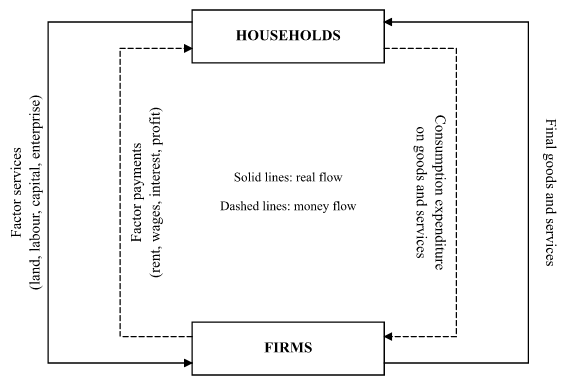 (a)(ii)The statement is correct. GDP is the market value of all final goods and services produced within the domestic territory of a country during an accounting year. Gross Value Added (GVA) of a production unit is the value of its output minus the value of intermediate goods it uses, i.e. the value it adds. When the value added by every production unit in the economy (primary, secondary and tertiary sectors) is summed, the intermediate goods are cancelled out and only the value of final goods remains. This avoids double counting, so the sum of GVA of all units is always equal to the GDP of the economy (product / value added method).OR (b)(i)No, I do not agree. GDP deflator is the ratio of Nominal GDP to Real GDP:Nominal GDP is output valued at current-year prices; real GDP is the same output valued at base-year prices. Their ratio therefore shows only the change in prices.Example: base year 2010, price ₹ 10, output 100 units; 2015, price ₹ 15, output 100 units.2010: Nominal GDP ; Real GDP ; Deflator 2015: Nominal GDP ; Real GDP ; Deflator Output is unchanged; nominal GDP rose only because prices rose by 50%, which the deflator (150) shows.(b)(ii)Income from property and entrepreneurship is the factor income earned in the form of rent, royalty, interest (from property) and profit (from entrepreneurship). It is the part of domestic income other than compensation of employees (and mixed income).
© examsnet.com
Go to Question: