Test Index
National Income Accounting
National Income Accounting

 CBSE Board Videos
© examsnet.com
Question : 26 of 50
Marks:
+1,
-0
(a) Discuss briefly the concept of circular flow of income in a two-sector model. (3)(b) “Real Gross Domestic Product (GDP) is a better indicator of economic growth of a nation as compared to the Nominal Gross Domestic Product (GDP).”Do you agree with the given statement? Justify your answer with a valid hypothetical numerical example. (3)
[CBSE 2024 58/1/1]
Solution:
(a) In a simple two-sector economy there are only households and firms (no government, no foreign sector, no saving).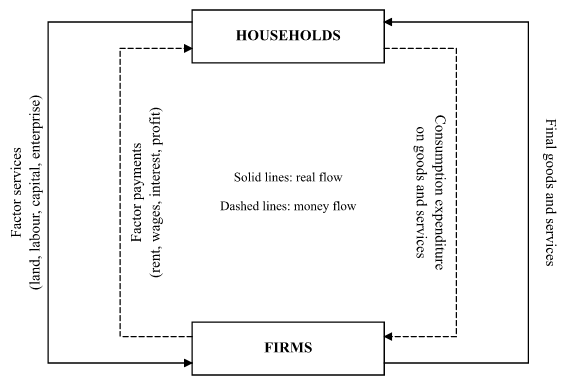 1. Households own the factors of production (land, labour, capital and entrepreneurship) and supply factor services to firms.2. Firms combine these factors to produce goods and services and make factor payments (rent, wages, interest and profit) to households. This is the income of households.3. Households spend their whole income on the goods and services produced by firms (consumption expenditure), and firms supply final goods and services to households.4. So the income earned by the factors flows back to the firms as expenditure, and the firms again pay it out as factor incomes. The flow continues without a break; this is the circular flow of income. At every point, Production = Income = Expenditure.(b) Yes, I agree.Nominal GDP is the money value of all final goods and services produced within the domestic territory in a year, measured at current year prices. Real GDP is the same output valued at base year (constant) prices.Nominal GDP can rise just because prices rise, even if output does not rise at all. Real GDP removes the effect of price changes, so it changes only when the physical output changes. Hence real GDP is the better indicator of economic growth.Hypothetical example:
Nominal GDP rose from ₹ 1,000 to ₹ 1,500, which suggests growth, but output stayed the same (100 units). Real GDP stayed at ₹ 1,000 and correctly shows no growth. So real GDP gives the true picture.
| Year | Price (₹) | Output (units) | Real GDP () | Nominal GDP () |
| 2010 (base year) | 10 | 100 | 1,000 | 1,000 |
| 2011 (current year) | 15 | 100 | 1,000 | 1,500 |
© examsnet.com
Go to Question: