Test Index
National Income Accounting
National Income Accounting

 CBSE Board Videos
© examsnet.com
Question : 20 of 50
Marks:
+1,
-0
(a) (i) On the basis of the data given below, estimate the value of National Income () (4)
(ii) Differentiate between Real flow and Money flow. (2)OR(b) (i) Gauhar, has recently completed her fashion designing studies and started a boutique. To produce dresses for sale, she purchased various materials, including a sewing machine, fabric, buttons and thread. These items are essential for producing the dresses.Classify the material purchased by Gauhar as Final or Intermediate goods, giving valid reasons in support of the classifications. (4)(ii) “National Income is always equal to Domestic income in a two sector economy.”Defend or refute the given statement with valid reasons. (2)
| S. No. | Items | Amount (₹ in crore) |
| (1) | Private final consumption expenditure | 2,000 |
| (2) | Government final consumption expenditure | 1,500 |
| (3) | Gross domestic fixed capital formation | 1,000 |
| (4) | Addition to stock | 400 |
| (5) | Consumption of fixed capital | 50 |
| (6) | Net factor income from abroad | 100 |
| (7) | Net indirect Taxes | 200 |
| (8) | Net Exports | 700 |
[CBSE 2025 58/2/1]
Solution:
(a)(i)Concept: By the expenditure method, GDP at market price is the sum of final expenditures. National Income () is obtained by subtracting depreciation, adding net factor income from abroad and subtracting net indirect taxes.Formula used: = Private final consumption expenditure + Government final consumption expenditure + Gross domestic fixed capital formation + Addition to stock + Net exportsi.e. National Income = (1) + (2) + (3) + (4) + (8) (5) + (6) (7)Solution: crore crore crore croreResult: National Income () = ₹ 5,450 crore(a)(ii)Real flow: the flow of goods and services between households and firms. Households supply factor services (land, labour, capital, entrepreneurship) to firms, and firms supply goods and services to households.Money flow: the flow of money between households and firms. Firms make factor payments (rent, wages, interest, profit) to households, and households spend money (consumption expenditure) on the goods and services of firms.Real flow is a flow of goods and services (physical, in kind); money flow is a flow of money payments in the opposite direction of the real flow.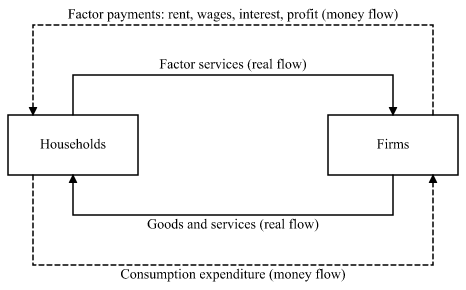 OR (b)(i)Concept: Final goods are goods bought for final use (consumption or investment) that are not resold or used up in production in the same year. Intermediate goods are used up as inputs in producing other goods during the same year.1. Sewing machine: Final good (capital good). Gauhar buys it for investment. It is used in production over many years and is not used up or merged into the dresses; it only wears out (depreciates). So it is part of gross investment, a final good.2. Fabric, buttons and thread: Intermediate goods. They are raw materials bought by one producer from another and are completely used up in making dresses for sale in the same year. Their value is already included in the price of the dresses, so counting them separately would mean double counting.OR (b)(ii)The statement is defended.National Income = Domestic Income () + Net Factor Income from Abroad (NFIA).A two-sector economy has only households and firms; it has no government and no foreign (rest of the world) sector, so it is a closed economy. There is no factor income earned from abroad or paid abroad, so NFIA = 0.Hence National Income = Domestic Income + 0, i.e. National Income is always equal to Domestic Income in a two-sector economy.
© examsnet.com
Go to Question: