Test Index
National Income Accounting
National Income Accounting

 CBSE Board Videos
© examsnet.com
Question : 17 of 50
Marks:
+1,
-0
(a) (i) Suppose, there are only three firms in a hypothetical economy, viz. A, B and C. During a given period of time, the following transactions were undertaken by them :(I) Firm A sold goods worth ₹ 2,000 to firm B and ₹ 1,200 to Firm C.(II) Firm B sold goods worth ₹ 1,100 to Firm A and ₹ 3,500 to Firm C.(III) Firm C sold to households for final consumption, goods worth ₹ 5,700.Estimate the value of Net Domestic Product at Market Price (NDPMP) assuming depreciation to be ₹ 120. (3)(ii) Explain the likely impact of construction of 2000 new schools providing high-quality education in a nation on Gross Domestic Product and welfare in an economy. (3)OR(b) (i) Distinguish between Real Gross Domestic Product (GDP) and Nominal Gross Domestic Product. (3)(ii) As per a news dated April 11, 2023 :“Electric Vehicle sales crossed one million mark in FY 2023.”Analyse its impact on Gross Domestic Product (GDP) and economic welfare. (3)
[CBSE 2025 58/6/1]
Solution:
(a)(i)Concept: By the value added method, GDPMP = sum of the gross value added of all firms, where Value added = Value of output − Intermediate consumption. Every firm’s purchase from another firm is intermediate consumption; only C’s sale to households is a final sale.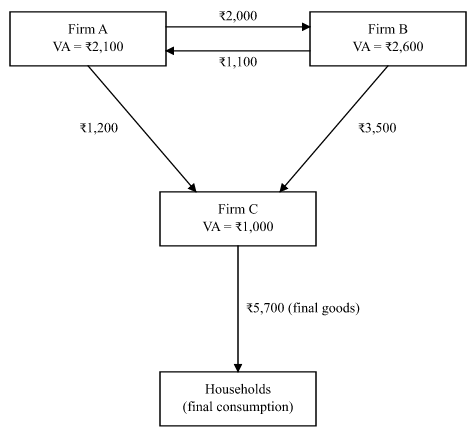
i.e. ₹ 5,700(Check: this equals the value of final goods sold to households, ₹ 5,700.)Result: NDPMP = ₹ 5,580(a)(ii)Impact on GDP (positive):1. Construction adds to output: building 2000 schools is investment (gross fixed capital formation); the value of this construction and of the materials used raises GDP directly.2. More employment and income: construction and later the running of the schools employ workers and teachers; their incomes are spent, which raises demand and output further (multiplier effect).3. Long-run growth: high-quality education builds human capital, raising the skill and productivity of workers, so GDP grows faster in the future.Impact on welfare (positive):4. Better education improves knowledge, earning ability, health awareness and civic participation of people, so their standard of living and well-being rise. Education also creates positive externalities (benefits to the society beyond the student).Hence both GDP and welfare are likely to increase.OR (b)(i)
For example, if prices rise but output stays the same, nominal GDP rises while real GDP does not change. .OR (b)(ii)Impact on GDP (positive):1. Sale of over one million electric vehicles means more final goods are produced and sold; the value added in making them (and their batteries and parts) adds directly to GDP.2. Higher production of EVs, charging stations and related services creates jobs and incomes, raising demand and output further.Impact on economic welfare (positive):3. EVs do not emit exhaust gases, so air pollution falls; cleaner air and better health of people is a positive externality that raises welfare beyond what GDP shows.4. EVs are energy-efficient and reduce dependence on imported petrol and diesel, lowering running costs for users and saving foreign exchange.Hence the rise in EV sales is likely to raise both GDP and economic welfare.
| Firm | Value of output (₹) | Intermediate consumption (₹) | Value added (₹) |
| A | 2,000 + 1,200 = 3,200 | 1,100 (bought from B) | 3,200 − 1,100 = 2,100 |
| B | 1,100 + 3,500 = 4,600 | 2,000 (bought from A) | 4,600 − 2,000 = 2,600 |
| C | 5,700 | 1,200 + 3,500 = 4,700 | 5,700 − 4,700 = 1,000 |
| Total | 13,500 | 7,800 | 5,700 |
| Basis | Real GDP | Nominal GDP |
| Meaning | Money value of all final goods and services produced within the domestic territory in a year, measured at constant (base year) prices | Money value of all final goods and services produced within the domestic territory in a year, measured at current year prices |
| What changes it | Changes only when the physical output changes | Changes when output changes or prices change (or both) |
| Use | True indicator of growth and of welfare over time | Can rise only due to inflation, so it can mislead about welfare |
© examsnet.com
Go to Question: