Test Index
Government Budget and the Economy
Government Budget and the Economy

 CBSE Board Videos
© examsnet.com
Question : 19 of 29
Marks:
+1,
-0
(a) (i) From the information given in the diagram, categorize the items into revenue receipts and capital receipts, stating valid reasons. (4)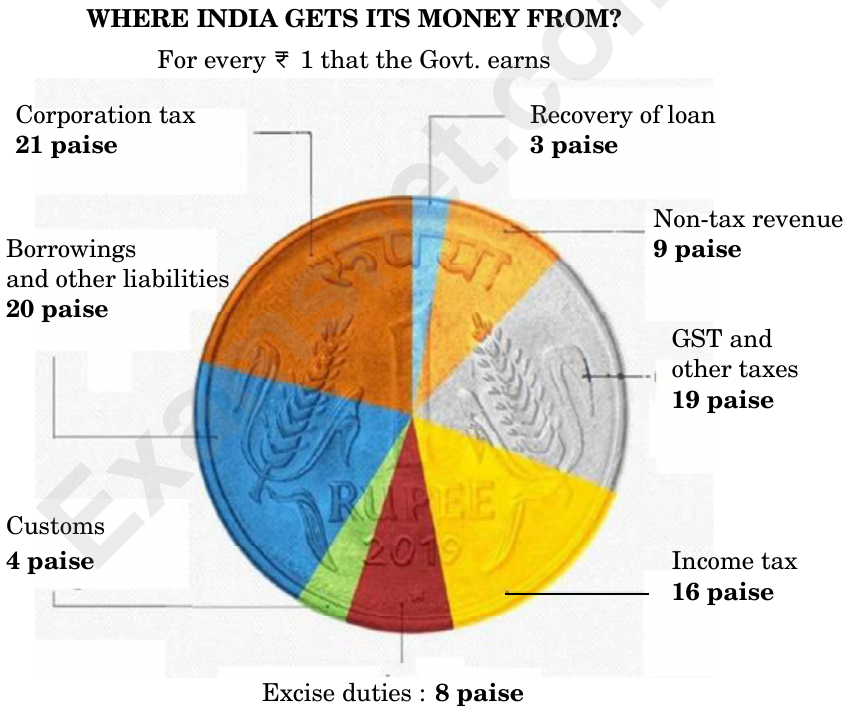 (ii) Distinguish between Revenue deficit and Fiscal deficit. (2)OR(b) (i) From the following data, calculate the primary deficit. (3)
(ii) Elaborate ‘Economic stability’ function of the Government Budget. (3)
| S. No. | Particulars | Amount (in ₹ crore) |
| (i) | Revenue deficit | 40 |
| (ii) | Non-debt creating capital receipts | 190 |
| (iii) | Tax revenue | 125 |
| (iv) | Capital expenditure | 220 |
| (v) | Interest payments | 20 |
[CBSE 2023 58/1/3]
Solution:
(a)(i)Revenue receipts: Corporation tax (21 paise), Income tax (16 paise), GST and other taxes (19 paise), Customs (4 paise), Excise duties (8 paise), Non-tax revenue (9 paise).Reason: these receipts neither create a liability for the government nor reduce its assets.Capital receipts: Borrowings and other liabilities (20 paise), Recovery of loans (3 paise).Reason: borrowings create a liability (they must be repaid), and recovery of loans reduces the assets of the government (the loans given earlier are its assets).(Revenue receipts paise; capital receipts paise of every rupee.)(a)(ii)Revenue deficit is the excess of the government's revenue expenditure over its revenue receipts during a fiscal year.Revenue deficit = Revenue expenditure - Revenue receipts.Fiscal deficit is the excess of the government's total expenditure over its total receipts excluding borrowings during a fiscal year.Fiscal deficit = Total expenditure - (Revenue receipts + Non-debt creating capital receipts) = Borrowings.Revenue deficit shows dissaving on the revenue account; fiscal deficit shows the total borrowing requirement of the government.OR (b)(i)Concept:Fiscal deficit = Revenue deficit + Capital expenditure - Non-debt creating capital receiptsPrimary deficit = Fiscal deficit - Interest paymentsSolution:Fiscal deficit Primary deficit (Tax revenue is already counted inside the revenue deficit, so it is not used again.)Result: Primary deficit = ₹ 50 croreOR (b)(ii)Economic stability function: an economy faces fluctuations in income, employment and prices (business cycles: boom and depression). These depend on the level of aggregate demand, which depends on the spending decisions of households and firms.The government uses the budget to correct these fluctuations:1. Inflation (excess demand): the government raises taxes and cuts its expenditure, which reduces aggregate demand and brings prices down.2. Deflation (deficient demand): the government cuts taxes, gives subsidies and raises its expenditure, which raises aggregate demand, output and employment.In this way the budget keeps income, employment and prices stable.
© examsnet.com
Go to Question: