Test Index
Government Budget and the Economy
Government Budget and the Economy

 CBSE Board Videos
© examsnet.com
Question : 14 of 29
Marks:
+1,
-0
(a) Classify the following as Revenue receipts or Capital receipts. Give valid arguments in support of your answer:(i) Interest received on loan. (2)(ii) Disinvestment receipts from the sale of a government company. (2)(iii) Financial assistance by the Government of USA for promoting girl education in India. (2)OR(b) (i) Study the following chart carefully and analyse the changing trends in the government expenditure on:(I) Transport (2)(II) Rural Development (2)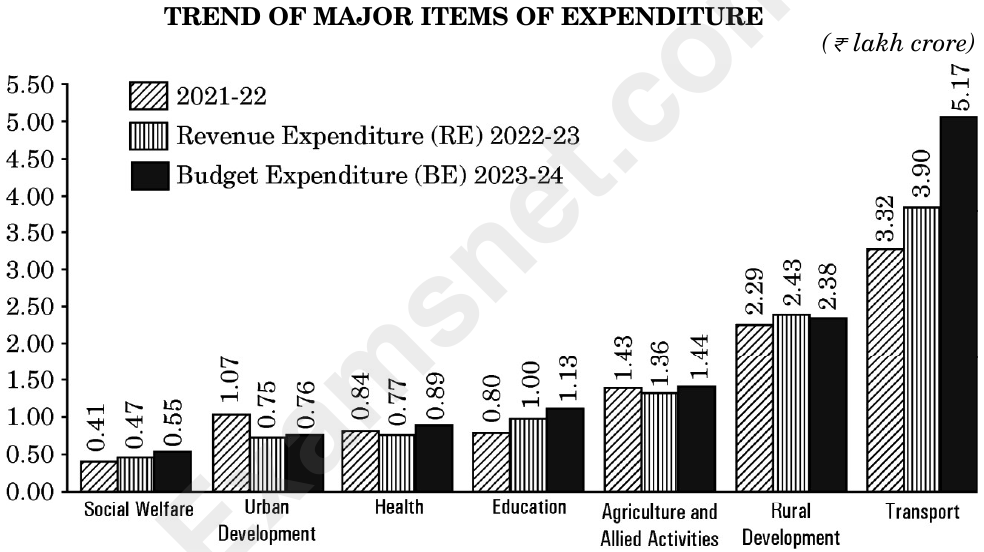 (ii) Distinguish between ‘fiscal deficit’ and ‘revenue deficit’. (2)
[CBSE 2024 58/1/1]
Solution:
(a) A receipt is a capital receipt if it either creates a liability or reduces the assets of the government; otherwise it is a revenue receipt.(a)(i) Interest received on loan: revenue receipt. It neither creates any liability for the government nor reduces its assets (the loan given remains an asset; only the interest on it is received). It is a non-tax revenue receipt.(a)(ii) Disinvestment receipts from the sale of a government company: capital receipt. The government sells its shares in a public sector company, so its assets are reduced.(a)(iii) Financial assistance by the Government of USA for girl education: revenue receipt. It is a grant (aid) which does not have to be repaid, so it creates no liability, and it does not reduce any asset of the government.OR (b)(i) (Figures in ₹ lakh crore for 2021-22, 2022-23 (RE) and 2023-24 (BE).)(I) Transport: expenditure rose continuously: 3.32 in 2021-22, 3.90 in 2022-23 and 5.17 in 2023-24. It rose by 0.58 in the first year and by a much larger 1.27 in the next, and it is the largest item in all three years. This shows the growing priority the government gives to transport infrastructure (roads, railways) to boost growth.(II) Rural Development: expenditure rose from 2.29 in 2021-22 to 2.43 in 2022-23 and then fell slightly to 2.38 in 2023-24. So it has stayed almost stable (small rise, then a marginal fall), in contrast to the sharp rise in transport.(b)(ii)
| Fiscal deficit | Revenue deficit |
| Excess of total expenditure of the government over its total receipts excluding borrowings. | Excess of revenue expenditure of the government over its revenue receipts. |
| Fiscal deficit = Total expenditure − Total receipts excluding borrowings | Revenue deficit = Revenue expenditure − Revenue receipts |
| It shows the total borrowing requirement of the government. | It shows dissaving: borrowing used to meet current (consumption) expenditure. |
© examsnet.com
Go to Question: