Test Index
Employment: Growth, Informalisation and Other Issues
Employment: Growth, Informalisation and Other Issues

 CBSE Board Videos
© examsnet.com
Question : 7 of 34
Marks:
+1,
-0
(a) Refer the given image carefully: (3)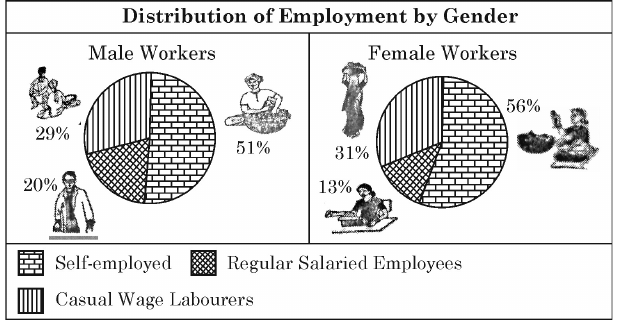 Compare and analyse the distribution of work force with respect to gender.(b) State the meaning of worker-population ratio. (1)
[CBSE 2026 58/2/1]
Solution:
(a)
Analysis:1. Self-employment is the major source of livelihood for both men and women: it covers more than half of both the male (51%) and the female (56%) workforce. It is a little higher for women.2. Casual wage labour is the second largest category for both: 29% of men and 31% of women; again the share of women is slightly higher.3. Regular salaried employment is more common among men (20%) than women (13%). Men have better access to regular jobs because these need skills and a higher level of literacy, and women’s mobility is limited.Conclusion: women are more concentrated in self-employment and casual work (87% together, against 80% of men), so a larger share of women workers lacks the regular income and job security of salaried jobs.(b)Worker-population ratio is the percentage of the population that is actually working (contributing to production):It shows the proportion of the population that is engaged in producing goods and services.
| Category | Male workers | Female workers |
| Self-employed | 51% | 56% |
| Casual wage labourers | 29% | 31% |
| Regular salaried employees | 20% | 13% |
© examsnet.com
Go to Question: