Test Index
Determination of Income and Employment
Determination of Income and Employment

 CBSE Board Videos
© examsnet.com
Question : 3 of 70
Marks:
+1,
-0
(a) Assume, for a hypothetical economy, the following data is given :
(i) Calculate the missing values in the given schedule. (1)(ii) Define the term ‘Effective Demand’. (2)(iii) On the basis of the given data, it can be said that the equilibrium level of income is 200.Do you agree ? If not, explain the adjustment mechanism that may take place to attain equilibrium level of income. (3)OR(b) Suppose, in an economy, every ₹ 1 increase in investment expenditure leads to an increase of ₹ 4 in the National Income.Calculate the following :(i) Value of Investment Multiplier (K). (1)(ii) Change in consumption expenditure, if the income changes from ₹ 400 to ₹ 500. (3)(iii) “Sum of Marginal Propensity to Consume (MPC) and Marginal Propensity to Save (MPS) is always equal to one.” Justify the given statement with the help of a suitable argument. (2)
| Income (Y) | Consumption (C) | Investment (I) | Aggregate Demand (AD) |
| 0 | 40 | 20 | 60 |
| 100 | 120 | 20 | – |
| 200 | 200 | 20 | – |
| 300 | 280 | 20 | 300 |
[CBSE 2026 58/5/1]
Solution:
(a)(i)Aggregate Demand is the sum of consumption and investment expenditure: .At : At :
(a)(ii)Effective Demand is that level of Aggregate Demand (AD) which is exactly met by the corresponding Aggregate Supply (AS) in the economy, i.e. the level of AD at which . It decides the equilibrium level of income and output (Keynes).(a)(iii)No, I do not agree. Equilibrium income is where (here AS = income , the 45° line).At : , so it is not the equilibrium.At : , so the equilibrium level of income is .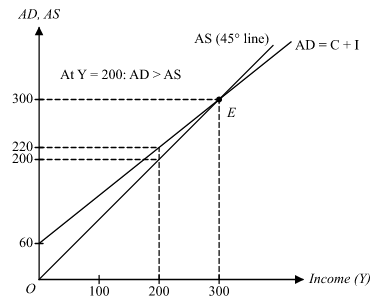 Adjustment mechanism (when AD > AS):1. Excess demand: at , households and firms plan to buy goods worth , but firms plan to produce only (ex-ante AD > ex-ante AS).2. Fall in inventories: the extra demand is met from stock, so inventories fall below the desired level.3. Rise in output: to restore the desired stock, producers raise production and employ more factors, so income rises.4. New equilibrium: output and income keep rising until , i.e. at .OR (b)Given:Change in investment ₹ 1, change in national income ₹ 4(b)(i)Result: Investment Multiplier (b)(ii)Change in income: ₹ 100, so , i.e. ₹ 75Result: Change in consumption expenditure = ₹ 75 (an increase).(b)(iii)Income is either consumed or saved:So any change in income is split between a change in consumption and a change in saving:Dividing both sides by :Hence the statement is true: the part of extra income not consumed is saved, so is always (e.g. here , so ).
| Income (Y) | Consumption (C) | Investment (I) | AD = C + I |
| 0 | 40 | 20 | 60 |
| 100 | 120 | 20 | 140 |
| 200 | 200 | 20 | 220 |
| 300 | 280 | 20 | 300 |
© examsnet.com
Go to Question: