Test Index
Determination of Income and Employment
Determination of Income and Employment

 CBSE Board Videos
© examsnet.com
Question : 25 of 70
Marks:
+1,
-0
(a) In an economy ; (where C is consumption expenditure and Y is National Income). Investment expenditure is ₹ 4,000 Crore.Calculate the following :(i) Equilibrium level of income.(ii) Total consumption expenditure at equilibrium income level.OR(b) Explain the adjustment mechanism in case ex-ante savings are greater than ex-ante investments.
[CBSE 2025 58/1/2]
Solution:
(a)Given: (autonomous consumption = ₹ 200 crore, MPC = 0.75)Investment I = ₹ 4,000 crore(i) Equilibrium level of incomeAt equilibrium, Y = AD = C + IResult: Equilibrium level of income = ₹ 16,800 crore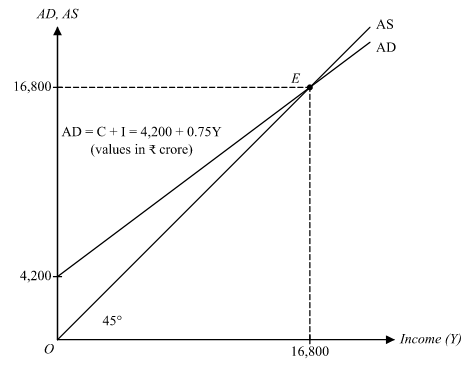 (ii) Consumption expenditure at equilibriumResult: Consumption expenditure = ₹ 12,800 croreCheck: C + I = 12,800 + 4,000 = 16,800 = Y. Also saving S = Y − C = 16,800 − 12,800 = 4,000 = I.OR (b)Meaning: Ex-ante (planned) saving greater than ex-ante (planned) investment means households plan to consume less than what firms expected to sell. So at the current output, aggregate demand is less than aggregate supply (AD < AS).Adjustment mechanism:1. Unsold goods pile up: Firms cannot sell all that they produced, so there is an unplanned (unintended) accumulation of inventories.2. Firms cut production: To bring inventories back to the desired level, producers plan to reduce output.3. Income falls: Lower output means lower employment and lower income in the economy.4. Saving falls: As income falls, planned saving also falls (saving depends on income).5. New equilibrium: This process continues until planned saving becomes equal to planned investment (S = I), that is AD = AS, at the equilibrium level of income .
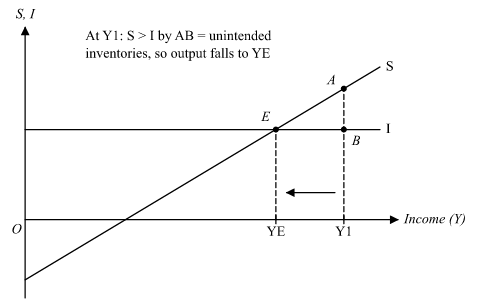 In the figure, at income saving (point A) exceeds investment (point B); the gap AB shows the unintended inventories, so output and income fall from to , where S = I at E.
© examsnet.com
Go to Question: