Test Index
Determination of Income and Employment
Determination of Income and Employment

 CBSE Board Videos
© examsnet.com
Question : 16 of 70
Marks:
+1,
-0
(a) “An economy is operating at under-employment level of income.”What does this situation indicate ? Discuss any one fiscal measure to tackle this situation.OR(b) Elaborate using a hypothetical numerical example, how a given initial increase in investment affects the level of final income of the economy.
[CBSE 2025 58/6/1]
Solution:
(a)What it indicates:Under-employment equilibrium means the economy is in equilibrium (AD = AS) at a level of income below the full-employment level. It indicates deficient demand: aggregate demand falls short of the aggregate supply at full employment. Resources lie idle, there is involuntary unemployment, and output, income and employment are low.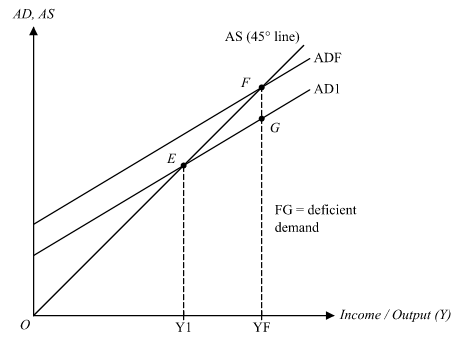 At full-employment income , AD is only while AS is ; the shortfall FG is the deficient demand. Equilibrium settles at E with income .Fiscal measure: increase government expenditure (expansionary fiscal policy)The government raises its spending on public works such as roads, bridges, schools and hospitals. Government expenditure (G) is a component of AD, so AD rises directly; the extra incomes paid out raise consumption further through the multiplier. AD shifts up from towards and income rises towards the full-employment level.(Another valid measure: reduce taxes, which raises disposable income, consumption and hence AD.)OR (b)Concept:The investment multiplier works because one person's expenditure is another person's income. An initial rise in investment raises income; a part of this extra income (MPC) is spent on consumption, which becomes income for others, and so on in successive rounds. Income finally rises by a multiple of the initial investment:Hypothetical example: Let investment rise by crore and MPC (so MPS ).
Working: crore crore, croreResult: An initial increase in investment of ₹ crore raises final income by ₹ crore. The process stops when the total extra saving ( crore) equals the initial extra investment.Key point: The higher the MPC, the larger the multiplier and the larger the final rise in income.
| Round | Increase in investment () (₹ crore) | Increase in income () (₹ crore) | Increase in consumption () (₹ crore) | Increase in saving () (₹ crore) |
| 1 | 1,000 | 1,000 | 800 | 200 |
| 2 | — | 800 | 640 | 160 |
| 3 | — | 640 | 512 | 128 |
| … | … | … | … | … |
| Total | 1,000 | 5,000 | 4,000 | 1,000 |
© examsnet.com
Go to Question: