Test Index
Comparative Development Experiences of India and its Neighbours
Comparative Development Experiences of India and its Neighbours

 CBSE Board Videos
© examsnet.com
Question : 19 of 60
Marks:
+1,
-0
On the basis of the given data, compare and analyse the Distribution of workforce and its contribution to Gross Value added in India and China.Sectoral Share of Employment and GVA (%) in 2018-2019
Source : Human Development Report 2019 : Key Indicators of Asia and Pacific 2019.
| Sector | Contribution to GVA | Distribution of Workforce | ||||
| India | China | Pakistan | India | China | Pakistan | |
| Agriculture | 16 | 7 | 24 | 43 | 26 | 41 |
| Industry | 30 | 41 | 19 | 25 | 28 | 24 |
| Services | 54 | 52 | 57 | 32 | 46 | 35 |
| Total | 100 | 100 | 100 | 100 | 100 | 100 |
[CBSE 2025 58/2/1]
Solution:
The table gives each sector's share in Gross Value Added (GVA) and in the workforce. Comparing the two shares tells us how productive the workers of a sector are.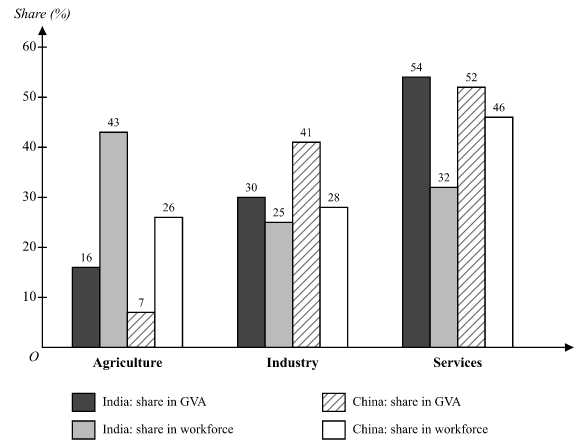 1. Agriculture: In India, 43% of the workforce produces only 16% of GVA; in China, 26% of the workforce produces 7% of GVA. India has a much larger share of its people dependent on agriculture, which shows heavy disguised unemployment and low productivity in Indian farming. China has moved a larger part of its workforce out of agriculture (its cultivable area is also relatively smaller because of its topography and climate).2. Industry: In China, industry contributes 41% of GVA with 28% of the workforce, against 30% of GVA with 25% of the workforce in India. Rapid industrialisation (manufacturing-led growth) has made industry the main engine of China's growth, while India's industrial sector is smaller.3. Services: Both countries get a similar share of GVA from services (India 54%, China 52%). But this share comes from only 32% of the workforce in India, against 46% in China. In India, growth has jumped from agriculture straight to services, and the service sector has not absorbed workers in proportion to its output.Conclusion: China has followed the classic path of development: workers shifted from agriculture to industry and then to services. India still has too many workers in low-productivity agriculture, and its growth is service-led without a matching rise in industry or employment.
© examsnet.com
Go to Question: