Test Index
The d- and f-Block Elements
The d- and f-Block Elements

 CBSE Board Videos
© examsnet.com
Question : 39 of 44
Marks:
+1,
-0
(a) (i) Silver atom has completely filled d-orbitals in its ground state, it is still considered to be a transition element. Justify the statement.(ii) Why are values of Mn and Zn more negative than expected ?(iii) Why do transition metals form alloys ? (3 × 1 = 3)OR(b) Answer the following questions on the basis of the figure given below : (3 × 1 = 3)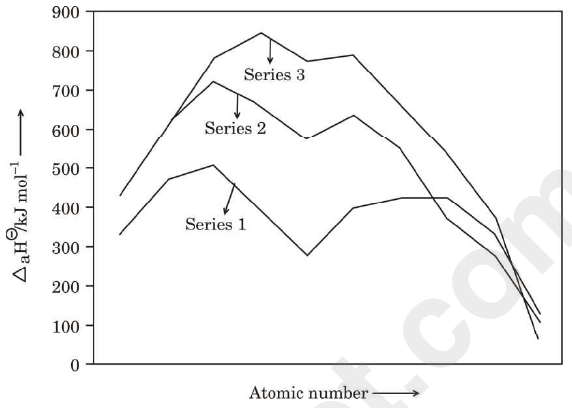 (i) Which element in 3d series has lowest enthalpy of atomisation ?(ii) Why do metals of the second and third series have greater enthalpies of atomisation ?(iii) Why are enthalpies of atomisation of transition metals quite high ?
[CBSE 2022 56/4/2]
Solution:
(a)(i) A transition element has incompletely filled d-orbitals in its ground state or in any of its common oxidation states. Silver () has a full d subshell as an atom, but in its +2 oxidation state (: ) the d-orbitals are incompletely filled. Hence silver is regarded as a transition element.(a)(ii) The values of Mn and Zn are more negative than expected because the ions formed are extra stable: has a half-filled configuration and has a completely filled configuration. (Zn also has a relatively low enthalpy of atomisation.) So both metals are oxidised to more readily.(a)(iii) Transition metals have similar atomic radii (and similar other characteristics), so the atoms of one metal can easily take up positions in the crystal lattice of another. Hence they readily form alloys (solid solutions).OR (b)(i) Zinc (Zn) has the lowest enthalpy of atomisation in the 3d series (its electrons do not take part in metallic bonding).(b)(ii) The 4d and 5d orbitals are larger and overlap better than 3d orbitals, so metals of the second and third series show more frequent and stronger metal-metal bonding in their compounds and metals. Hence they have greater enthalpies of atomisation.(b)(iii) Transition metals have a large number of unpaired electrons in their atoms, which take part in metallic bonding. This gives strong interatomic (metallic) bonding, so a large amount of energy is needed to atomise them. Hence their enthalpies of atomisation are high.
© examsnet.com
Go to Question: