Test Index
The d- and f-Block Elements
The d- and f-Block Elements

 CBSE Board Videos
© examsnet.com
Question : 35 of 44
Marks:
+1,
-0
(a) Why is chemistry of actinoids complicated as compared to lanthanoids ? (1)(b) Complete the following reaction and justify that it is a disproportionation reaction : (2)(c) The given graph shows the trends in melting points of transition metals :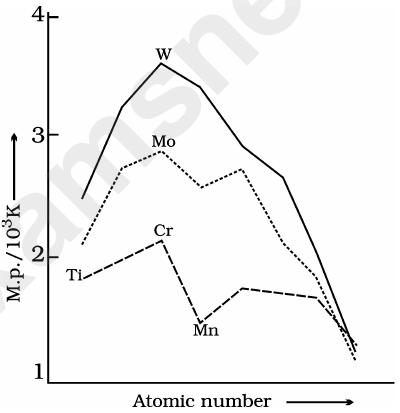 Explain the reason why Cr has highest melting point and manganese (Mn) a lower melting point. (2)
[CBSE 2023 56/5/1]
Solution:
(a)Actinoids show a much wider range of oxidation states (because 5f, 6d and 7s levels have comparable energies), and most of them are radioactive with short half-lives, which makes their study in the laboratory difficult. So their chemistry is more complicated than that of the lanthanoids.(b)Oxidation state of Mn: in , in and in .The same element (Mn, +6) is simultaneously oxidised (to +7) and reduced (to +4). So it is a disproportionation reaction.(c)Melting points of transition metals depend on the strength of metallic bonding, which increases with the number of unpaired d electrons taking part in bonding.Cr () has 6 unpaired electrons, the maximum in the series, so it has strong interatomic metal–metal bonding and the highest melting point.Mn () has a stable half-filled configuration; its d electrons are held tightly and take little part in metallic bonding, so the metallic bonds are weaker and its melting point is lower.
© examsnet.com
Go to Question: