Test Index
Solutions
Solutions

 CBSE Board Videos
© examsnet.com
Question : 17 of 52
Marks:
+1,
-0
According to the generally accepted definition of the ideal solution there are equal interaction forces acting between molecules belonging to the same or different species. (This is equivalent to the statement that the activity of the components equals the concentration.) Strictly speaking, this condition is fulfilled only in exceptional cases for mixtures (optical isomers, isotopic mixtures of an element, hydrocarbon mixtures). It is still usual to talk about ideal solutions as limiting cases in reality since very dilute solutions behave ideally with respect to the solvent. This view is further supported by the fact that Raoult's law empirically found for describing the behaviour of the solvent in dilute solutions can be deduced thermodynamically via the assumption of ideal behaviour of the solvent.Answer the following questions :(a) Give one example of miscible liquid pair which shows negative deviation from Raoult's law. What is the reason for such deviation ? (2)(b) (i) State Raoult's law for a solution containing volatile components. (1)OR(b) (ii) Raoult's law is a special case of Henry's law. Comment. (1)(c) Write two characteristics of an ideal solution. (1)
[CBSE 2025 56/4/2]
Solution:
(a)Example: a mixture of chloroform () and acetone (). (Other examples: phenol + aniline; nitric acid + water.)Reason: in the solution the A–B attractive forces are stronger than the A–A and B–B forces. In chloroform + acetone, the chloroform molecule forms a hydrogen bond with the carbonyl oxygen of acetone:This lowers the escaping tendency of the molecules, so the vapour pressure of the solution is lower than that predicted by Raoult's law (with and ).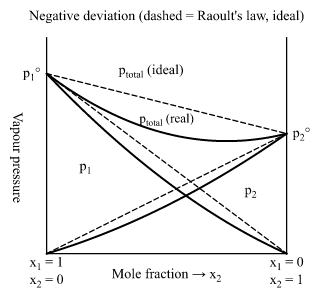 (b)(i)Raoult's law: for a solution of volatile liquids, the partial vapour pressure of each component is directly proportional to its mole fraction in the solution., and where , are the vapour pressures of the pure components and , their mole fractions.OR (b)(ii)Henry's law: (partial pressure of a gas over the solution is proportional to its mole fraction in the solution).Raoult's law: .Both say that the partial vapour pressure of a component is proportional to its mole fraction; only the proportionality constant differs. When (vapour pressure of the pure component), Henry's law becomes Raoult's law. So Raoult's law is a special case of Henry's law.(c)Any two of:(1) It obeys Raoult's law over the entire range of concentration.(2) (no heat is absorbed or evolved on mixing).(3) (volume of solution = sum of the volumes of the components).(A–B interactions are of the same strength as A–A and B–B interactions.)
© examsnet.com
Go to Question: