Test Index
Haloalkanes and Haloarenes
Haloalkanes and Haloarenes

 CBSE Board Videos
© examsnet.com
Question : 8 of 47
Marks:
+1,
-0
Answer the following :(a) Which isomer of is most reactive towards reaction ?(b) Predict the alkene that would be formed by dehydrohalogenation of 1-Bromo-1-methylcyclohexane.(c) Although chlorine shows strong effect, yet it is ortho- and para-directing in electrophilic aromatic substitution reactions. Why ?
[CBSE 2026 56/4/2]
Solution:
(a) reactivity follows carbocation stability: . The tertiary isomer forms the most stable carbocation .Most reactive: , 2-bromo-2-methylpropane (tert-butyl bromide).(b) With alcoholic KOH, H is removed from a β-carbon along with Br. By Saytzeff (Zaitsev) rule the more substituted alkene is the major product: 1-methylcyclohexene (H taken from a ring β-carbon). Methylenecyclohexane (H taken from the group) is formed only in small amount.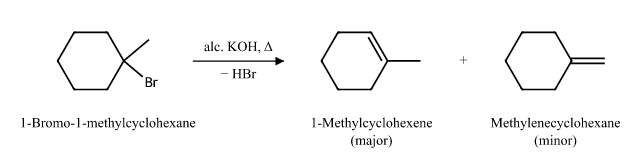 (c) Chlorine withdraws electrons through the σ-bond ( effect), so it deactivates the ring as a whole. But its lone pairs are in conjugation with the ring ( effect), which raises the electron density at the ortho and para positions more than at meta. The +R effect also stabilises the carbocation (arenium ion) formed by attack at ortho and para positions, through a resonance form in which Cl carries the positive charge (). Hence substitution, though slower than in benzene, takes place at ortho and para positions.Key point: In chlorobenzene the effect controls the rate (deactivation), while the effect controls the orientation (o/p).
© examsnet.com
Go to Question: