Test Index
Haloalkanes and Haloarenes
Haloalkanes and Haloarenes

 CBSE Board Videos
© examsnet.com
Question : 5 of 47
Marks:
+1,
-0
(a) (i) (I) Which of the following is more reactive towards reaction : (1)2-Bromo-2-methylbutane or 1-Bromopentane(II) What type of halide is present in the following compound : (1)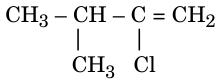 (III) Why is chloroform stored in dark coloured bottles ? (1)(ii) Define the following terms : (1+1)(I) Ambident Nucleophiles(II) Racemic mixtureOR(b) (i) Answer the following : (3)(I) Which isomer of is most reactive towards reaction ?(II) Predict the alkene that would be formed by dehydrohalogenation of 1-Bromo-1-methylcyclohexane.(III) Although chlorine shows strong effect, yet it is ortho/para-directing in electrophilic aromatic substitution reactions. Why ?(ii) Write the major product in the following reactions : (2)(I)
 (II)
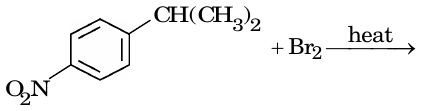
[CBSE 2026 56/5/3]
Solution:
(a)(i)(I)2-Bromo-2-methylbutane, , is more reactive. It is a tertiary halide; it ionises to a tertiary carbocation, which is stabilised by hyperconjugation and the effect of three alkyl groups. 1-Bromopentane would have to form an unstable primary carbocation.(a)(i)(II)The chlorine is attached to an carbon of the double bond: it is a vinylic halide.(a)(i)(III)In the presence of light, chloroform is slowly oxidised by air to the extremely poisonous gas phosgene (carbonyl chloride):Dark coloured bottles cut off the light; the bottles are also filled completely so that no air is left in them.(a)(ii)(I)Ambident nucleophiles: nucleophiles that have two different nucleophilic sites and can attack through either of them. Example: the cyanide ion attacks through C (giving alkyl cyanides) or through N (giving isocyanides); the nitrite ion attacks through O (alkyl nitrites) or N (nitroalkanes).(a)(ii)(II)Racemic mixture: an equimolar mixture of the two enantiomers ( and forms) of a compound. It is optically inactive (zero optical rotation), because the rotation caused by one enantiomer is cancelled by the other (external compensation).OR (b)(i)(I)2-Bromo-2-methylpropane (tert-butyl bromide), . It is the only tertiary isomer of and forms the most stable (tertiary) carbocation.(b)(i)(II)On heating with alcoholic KOH, the hydrogen is removed from the ring carbon next to (Saytzeff rule: the more substituted alkene is the major product). The major product is 1-methylcyclohexene (methylenecyclohexane is the minor product).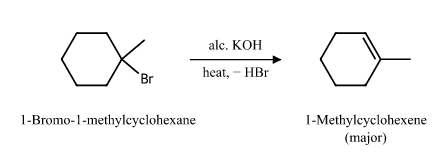 (b)(i)(III)Chlorine withdraws electrons through the effect, so it deactivates the ring (reactions are slower than with benzene). But the lone pairs on chlorine are donated to the ring by resonance ( effect), which builds up electron density at the ortho and para positions. The carbocation (arenium ion) formed by attack at ortho or para positions is further stabilised by a resonance structure in which chlorine carries the positive charge. So the effect decides the reactivity, while the effect decides the orientation: chlorine is ortho/para-directing.(b)(ii)
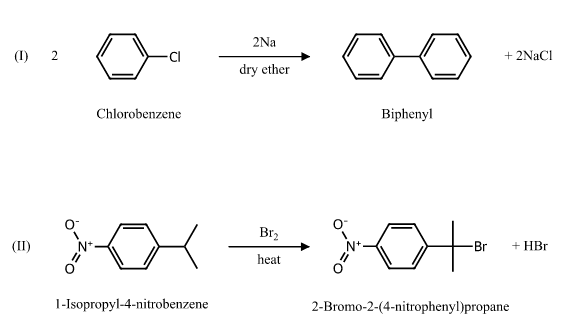 (I) Fittig reaction: two aryl groups couple. Product: biphenyl, (II) With on heating (no Lewis acid), bromination takes place by a free radical mechanism at the benzylic carbon of the side chain (the benzylic radical is resonance stabilised; the ring is also deactivated by ). The tertiary benzylic hydrogen is replaced. Product: 2-bromo-2-(4-nitrophenyl)propane, (+ HBr).
© examsnet.com
Go to Question: