Test Index
Haloalkanes and Haloarenes
Haloalkanes and Haloarenes

 CBSE Board Videos
© examsnet.com
Question : 37 of 47
Marks:
+1,
-0
The following questions are case-based questions. Read the case carefully and answer the questions that follow.The polarity of bond of alkyl halides is responsible for their nucleophilic substitution, elimination and their reaction with metal atoms to form organometallic compounds. Alkyl halides are prepared by the free radical halogenation of alkanes, addition of halogen acids to alkenes, replacement of group of alcohols with halogens using phosphorus halides, thionyl chloride or halogen acids. Aryl halides are prepared by electrophilic substitution of arenes. Nucleophilic substitution reactions are categorised into and on the basis of their kinetic properties. Chirality has a profound role in understanding the and mechanism.Answer the following questions :(i) What happens when bromobenzene is treated with Mg in the presence of dry ether ? (1)(ii) Which compound in each of the following pairs will react faster in reaction with ? (1)(1) or (2) or (iii) Write the equations for the preparation of 1-iodobutane from ()(1) 1-chlorobutane(2) but-1-ene.OR(iii) Write the structure of the major products in each of the following reactions : ()(1) (2)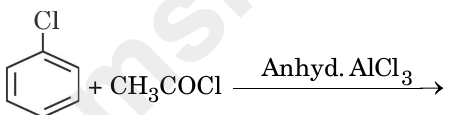
[CBSE 2023 56/3/1]
Solution:
(i)Bromobenzene reacts with Mg in dry ether to form a Grignard reagent, phenylmagnesium bromide:(ii)(1) reacts faster. It forms the allylic carbocation , which is stabilised by resonance; (a primary carbocation) has no such stabilisation.(2) reacts faster. It forms the stable tertiary carbocation ; the methyl carbocation is very unstable.(iii)(1) From 1-chlorobutane (Finkelstein reaction):(NaCl precipitates in acetone and drives the reaction forward.)(2) From but-1-ene (anti-Markovnikov addition of HBr in presence of peroxide, then Finkelstein reaction):OR (iii)(1) Dehydrohalogenation (-elimination) with alcoholic KOH:Major product: propene.(2) Friedel–Crafts acylation. Cl is ortho/para directing; the para product is major because of less steric hindrance: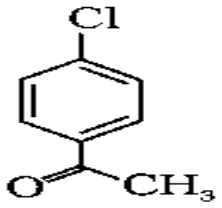 Major product: 4-chloroacetophenone, (with some 2-chloroacetophenone as the minor product).
© examsnet.com
Go to Question: