Test Index
Haloalkanes and Haloarenes
Haloalkanes and Haloarenes

 CBSE Board Videos
© examsnet.com
Question : 30 of 47
Marks:
+1,
-0
An alkyl halide (A) of molecular formula on treatment with alcoholic KOH gives two isomeric alkenes (B) and (C) of molecular formula . Both alkenes on hydrogenation give 2,3-dimethylbutane. Write the structures of (A), (B) and (C).
[CBSE 2023 56/4/2]
Solution:
Concept:Both alkenes give the same alkane, 2,3-dimethylbutane , on hydrogenation, so (A), (B) and (C) all have this carbon skeleton. Two different alkenes are formed only if Cl is on C-2 (a tertiary carbon), so that -hydrogens can be lost from two different kinds of carbon.(A) 2-Chloro-2,3-dimethylbutane: (B) 2,3-Dimethylbut-1-ene: (minor, H lost from )(C) 2,3-Dimethylbut-2-ene: (major, more substituted alkene, Saytzeff rule)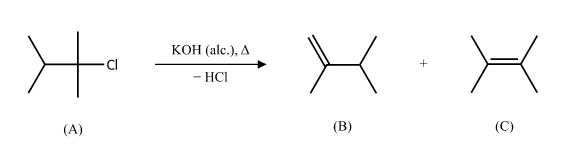 Both (B) and (C) (2,3-dimethylbutane).Key point: 1-Chloro-2,3-dimethylbutane would give only one alkene (2,3-dimethylbut-1-ene), so it cannot be (A).
© examsnet.com
Go to Question: