Test Index
Haloalkanes and Haloarenes
Haloalkanes and Haloarenes

 CBSE Board Videos
© examsnet.com
Question : 21 of 47
Marks:
+1,
-0
(a) Draw the structures of major monohalo products in each of the following reactions: (1+1=2)(i)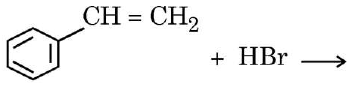 (ii)
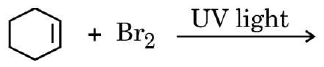 OR(b) Give reasons for the following: (1+1=2)(i) Grignard reagent should be prepared under anhydrous conditions.(ii) Alkyl halides give alcohol with aqueous KOH whereas in the presence of alcoholic KOH, alkenes are formed.
[CBSE 2024 56/1/1]
Solution:
(a)(i)HBr adds to styrene by Markovnikov's rule. adds to the terminal and gives the benzylic carbocation , which is stabilised by resonance with the ring. then attaches to this carbon.Major product: (1-bromo-1-phenylethane)(a)(ii)With in UV light, cyclohexene undergoes free-radical substitution at the allylic carbon (the next to the double bond), because the allylic radical is resonance stabilised.Major product: 3-bromocyclohexene (+ HBr)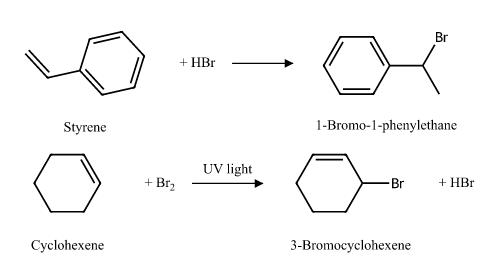 OR (b)(i)Grignard reagents are highly reactive. They react with water (or any compound with an acidic H) and are destroyed, forming an alkane:So they must be prepared (and used) under anhydrous conditions.(b)(ii)In aqueous KOH, the ion is strongly hydrated, so it acts mainly as a nucleophile and substitutes the halogen: .Alcoholic KOH contains alkoxide ions (), which are stronger bases. They remove a -hydrogen, and dehydrohalogenation (-elimination) gives an alkene: .
© examsnet.com
Go to Question: