Test Index
Haloalkanes and Haloarenes
Haloalkanes and Haloarenes

 CBSE Board Videos
© examsnet.com
Question : 19 of 47
Marks:
+1,
-0
A compound (A) with molecular formula which is a primary alkyl halide, reacts with alcoholic KOH to give compound (B). Compound (B) reacts with HI to give (C) which is an isomer of (A). When (A) reacts with Na metal in the presence of dry ether, it gives a compound (D), , which is different from the compound formed when n-butyl iodide reacts with sodium. Write the structures of (A), (B), (C) and (D). Write the chemical equation when compound (A) is reacted with alcoholic KOH.
[CBSE 2025 56/7/3]
Solution:
Reasoning:(A) is a primary but is not n-butyl iodide (its Wurtz product differs from that of n-butyl iodide). The only other primary isomer is isobutyl iodide. Dehydrohalogenation gives 2-methylpropene, which adds HI by Markovnikov's rule to give tert-butyl iodide, an isomer of (A).(A) : 1-Iodo-2-methylpropane(B) : 2-Methylpropene(C) : 2-Iodo-2-methylpropane(D) : 2,5-Dimethylhexane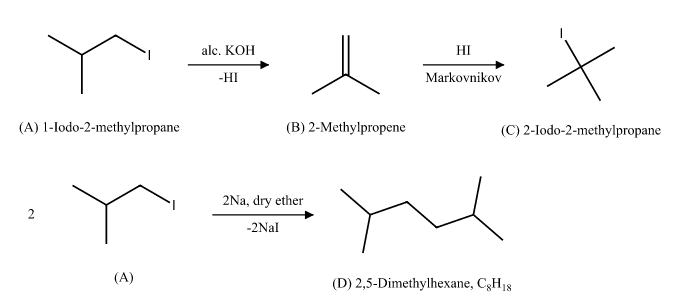 Reactions:(A) with alcoholic KOH: (B) to (C): Wurtz reaction: (n-Butyl iodide would give n-octane, , so (D) is a different .)
© examsnet.com
Go to Question: