Test Index
Electrochemistry
Electrochemistry

 CBSE Board Videos
© examsnet.com
Question : 48 of 48
Marks:
+1,
-0
Read the passage given below and answer the questions that follow:Oxidation-reduction reactions are commonly known as redox reactions. They involve transfer of electrons from one species to another. In a spontaneous reaction, energy is released which can be used to do useful work. The reaction is split into two half reactions. Two different containers are used and a wire is used to drive the electrons from one side to the other and a Voltaic/Galvanic cell is created. It is an electrochemical cell that uses spontaneous redox reactions to generate electricity. A salt bridge also connects to the half cells. The reading of the voltmeter gives the cell voltage or cell potential or electromotive force. If is positive the reaction is spontaneous and if it is negative the reaction is non-spontaneous and is referred to as electrolytic cell. Electrolysis refers to the decomposition of a substance by an electric current. One mole of electric charge when passed through a cell will discharge half a mole of divalent metal ion such as . This was first formulated by Faraday in the form of laws of electrolysis.The conductance of material is the property of materials due to which a material allows the flow of ions through itself and thus conducts electricity. Conductivity is represented by and it depends upon nature and concentration of electrolyte, temperature etc. A more common term molar conductivity of a solution at a given concentration is conductance of the volume of solution containing one mole of electrolyte kept between two electrodes with the unit area of cross-section and distance of unit length. Limiting molar conductivity of weak electrolytes cannot be obtained graphically.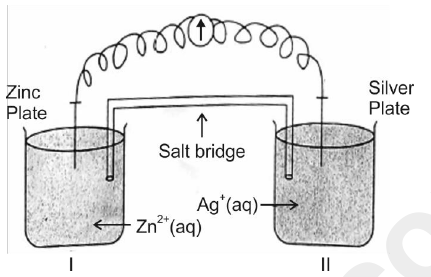 (a) Is silver plate the anode or cathode? [1](b) What will happen if the salt bridge is removed? [1](c) When does electrochemical cell behaves like an electrolytic cell? [1](d) (i) What will happen to the concentration of and when . [1 × 2 = 2](ii) Why does conductivity of a solution decreases with dilution?OR(d) The molar conductivity of a 1.5 M solution of an electrolyte is found to be . Calculate the conductivity of this solution. [2]
[CBSE 2022 56/5/3]
Solution:
(a) Zinc is more reactive and is oxidised (); is reduced at the silver plate (). Reduction takes place at the cathode, so the silver plate is the cathode.(b) The two half cells lose their electrical contact and electrical neutrality of the solutions is not maintained, so the flow of current stops: the cell stops working (the voltmeter reads zero).(c) When an external opposing potential greater than is applied (), the current flows in the opposite direction and the cell behaves as an electrolytic cell.(d)(i) When the cell reaction has reached equilibrium, so the concentrations of and no longer change.(d)(ii) Conductivity is the conductance of unit volume (1 cm³) of solution. On dilution the number of ions per unit volume decreases, so conductivity decreases.OR (d)Given: , so Result: Conductivity .
© examsnet.com
Go to Question: