© examsnet.com
Question : 34 of 48
Marks: +1, -0
(a) (i) Calculate the emf of the following cell at 298 K :
Al (s)∣Al3+(0.001 M)∥Ni2+(0.1 M)∣Ni (s)\text{Al (s)} \mid \text{Al}^{3+} (0.001 \text{ M}) \parallel \text{Ni}^{2+} (0.1 \text{ M}) \mid \text{Ni (s)}
[Given : EAl3+/Al∘=−1.66 VE^\circ_{\text{Al}^{3+}/\text{Al}} = -1.66 \text{ V}, ENi2+/Ni∘=−0.25 VE^\circ_{\text{Ni}^{2+}/\text{Ni}} = -0.25 \text{ V}, log⁡10=1\log 10 = 1]
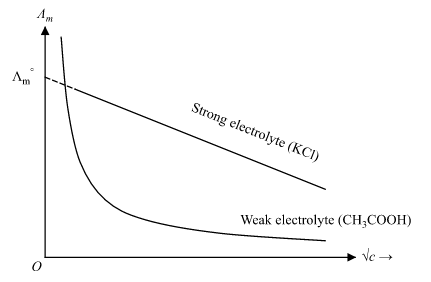
(ii) With the help of a graph explain why it is not possible to determine Λm∘\Lambda_m^\circ for a weak electrolyte by extrapolating the molar conductivity (Λm\Lambda_m) versus C1/2C^{1/2} curve as for strong electrolyte. (3+2=53 + 2 = 5)
OR
(b) (i) The molar conductivities of NH4+\text{NH}_4^+ and Cl−\text{Cl}^- ion are 73.8 S cm2 mol−173.8 \text{ S cm}^2 \text{ mol}^{-1} and 76.2 S cm2 mol−176.2 \text{ S cm}^2 \text{ mol}^{-1} respectively. The conductivity of 0.1 M NH4Cl\text{NH}_4\text{Cl} is 1.29×10⁻² S cm−11.29 \times 10^{-2} \text{ S cm}^{-1}. Calculate its molar conductivity and degree of dissociation.
(ii) Calculate the half-cell potential at 298 K for the reaction
Zn2++2e−⟶Zn\text{Zn}^{2+} + 2e^- \longrightarrow \text{Zn}
if [Zn2+]=0.1 M[\text{Zn}^{2+}] = 0.1 \text{ M} and EZn2+/Zn∘=−0.76 VE^\circ_{\text{Zn}^{2+}/\text{Zn}} = -0.76 \text{ V}. (3+2=53 + 2 = 5)
[CBSE 2023 56/4/2]
Solution:  
(a)(i)
Given: EAl3+/Al∘=−1.66E^\circ_{\text{Al}^{3+}/\text{Al}} = -1.66 V, ENi2+/Ni∘=−0.25E^\circ_{\text{Ni}^{2+}/\text{Ni}} = -0.25 V, [Al3+]=0.001[\text{Al}^{3+}] = 0.001 M, [Ni2+]=0.1[\text{Ni}^{2+}] = 0.1 M
Cell reaction: 2Al(s)+3Ni2+(aq)→2Al3+(aq)+3Ni(s)2\text{Al(s)} + 3\text{Ni}^{2+}\text{(aq)} \rightarrow 2\text{Al}^{3+}\text{(aq)} + 3\text{Ni(s)}, n=6n = 6
Ecell∘=Ecathode∘−Eanode∘=−0.25−(−1.66)=1.41E^\circ_{\text{cell}} = E^\circ_{\text{cathode}} - E^\circ_{\text{anode}} = -0.25 - (-1.66) = 1.41 V
Ecell=Ecell∘−0.059nlog⁡[Al3+]2[Ni2+]3E_{\text{cell}} = E^\circ_{\text{cell}} - \dfrac{0.059}{n} \log \dfrac{[\text{Al}^{3+}]^2}{[\text{Ni}^{2+}]^3}
=1.41−0.0596log⁡(10−3)2(10−1)3=1.41−0.0596log⁡10−3= 1.41 - \dfrac{0.059}{6} \log \dfrac{(10^{-3})^2}{(10^{-1})^3} = 1.41 - \dfrac{0.059}{6} \log 10^{-3}
=1.41+0.059×36=1.41+0.0295= 1.41 + \dfrac{0.059 \times 3}{6} = 1.41 + 0.0295
Result: Ecell=1.4395 V≈1.44 VE_{\text{cell}} = 1.4395 \text{ V} \approx 1.44 \text{ V}
(a)(ii)
For a strong electrolyte (KCl), Λm\Lambda_m falls slightly and linearly with c\sqrt{c} (Λm=Λm∘−Ac\Lambda_m = \Lambda_m^\circ - A\sqrt{c}), so the straight line can be extended to c=0c = 0 to read Λm∘\Lambda_m^\circ.
For a weak electrolyte (CH3COOH\text{CH}_3\text{COOH}), Λm\Lambda_m rises very steeply at low concentration because the degree of dissociation increases sharply on dilution. The curve is not linear and becomes almost parallel to the Λm\Lambda_m axis near c=0c = 0, so it cannot be extrapolated to give an intercept. (Λm∘\Lambda_m^\circ for a weak electrolyte is found by Kohlrausch's law instead.)
OR (b)(i)
Given: λ∘(NH4+)=73.8\lambda^\circ(\text{NH}_4^+) = 73.8, λ∘(Cl−)=76.2 S cm2 mol−1\lambda^\circ(\text{Cl}^-) = 76.2 \text{ S cm}^2\text{ mol}^{-1}, κ=1.29×10⁻² S cm−1\kappa = 1.29 \times 10^{-2} \text{ S cm}^{-1}, c=0.1c = 0.1 M
Λm=κ×1000c=1.29×10−2×10000.1=129 S cm2 mol−1\Lambda_m = \dfrac{\kappa \times 1000}{c} = \dfrac{1.29 \times 10^{-2} \times 1000}{0.1} = 129 \text{ S cm}^2\text{ mol}^{-1}
Λm∘(NH4Cl)=73.8+76.2=150 S cm2 mol−1\Lambda_m^\circ(\text{NH}_4\text{Cl}) = 73.8 + 76.2 = 150 \text{ S cm}^2\text{ mol}^{-1} (Kohlrausch's law)
α=ΛmΛm∘=129150=0.86\alpha = \dfrac{\Lambda_m}{\Lambda_m^\circ} = \dfrac{129}{150} = 0.86
Result: Λm=129 S cm2 mol−1\Lambda_m = 129 \text{ S cm}^2\text{ mol}^{-1}, α=0.86\alpha = 0.86
(b)(ii) Zn2++2e−→Zn\text{Zn}^{2+} + 2e^- \rightarrow \text{Zn}, n=2n = 2
E=E∘−0.0592log⁡1[Zn2+]=−0.76−0.0592log⁡10.1E = E^\circ - \dfrac{0.059}{2} \log \dfrac{1}{[\text{Zn}^{2+}]} = -0.76 - \dfrac{0.059}{2} \log \dfrac{1}{0.1}
=−0.76−0.0295×1= -0.76 - 0.0295 \times 1
Result: EZn2+/Zn=−0.7895 V≈−0.79 VE_{\text{Zn}^{2+}/\text{Zn}} = -0.7895 \text{ V} \approx -0.79 \text{ V}
© examsnet.com
Advertisements
Go to Question: