Test Index
Electrochemistry
Electrochemistry

 CBSE Board Videos
© examsnet.com
Question : 2 of 48
Marks:
+1,
-0
State Kohlrausch's law of independent migration of ions. With the help of a curve, explain why it is not easy to determine for weak electrolytes by extrapolating the concentration – molar conductivity curve, as it is for strong electrolytes.
[CBSE 2026 56/3/2]
Solution: 👈: Video Solution
Kohlrausch's law: The limiting molar conductivity of an electrolyte is the sum of the limiting molar conductivities of its cation and anion, each ion contributing independently of the other:where and are the numbers of cations and anions given by one formula unit. E.g. .Variation of with :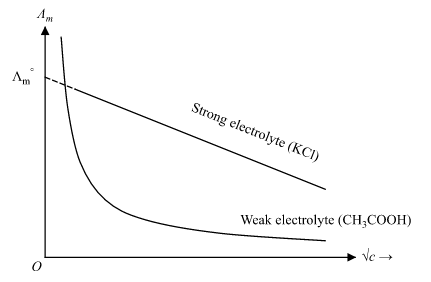 Explanation:• Strong electrolyte (e.g. KCl): it is fully ionised at all concentrations. rises only slightly on dilution, following , a straight line. Extending the line to gives as the intercept.• Weak electrolyte (e.g. ): its degree of dissociation is small and increases sharply on dilution, so rises very steeply near . The curve becomes almost parallel to the axis and does not meet it at a definite point, so it cannot be extrapolated to read . For weak electrolytes is obtained from Kohlrausch's law instead, e.g. .
© examsnet.com
Go to Question: