Test Index
Coordination Compounds
Coordination Compounds

 CBSE Board Videos
© examsnet.com
Question : 30 of 41
Marks:
+1,
-0
Answer any three of the following questions : ()(a) Explain the type of hybridization in on the basis of valence bond theory. (Given : Atomic number of Fe = 26)(b) Draw the geometrical isomers of ion.(c) is paramagnetic while is diamagnetic though both are tetrahedral. Why ?(d) Name the type of isomerism when ambidentate ligands are attached to central metal ion. Give one example of ambidentate ligand.
[CBSE 2023 56/4/2]
Solution:
(a) Fe (): ; : (five unpaired electrons in the free ion). is a strong field ligand, so it forces the electrons to pair: : ↑↓ ↑↓ ↑ _ _Two orbitals become empty. They mix with one and three orbitals to give six hybrid orbitals, which accept six electron pairs from six ions.: ↑↓ ↑↓ ↑ | ×× ×× | 4s ×× | 4p ×× ×× ×× (×× = pair from )Hybridisation: (inner orbital complex), octahedral, low spin, one unpaired electron (paramagnetic).(b) is octahedral and exists as cis and trans isomers. In the cis isomer the two are adjacent (); in the trans isomer they are opposite ().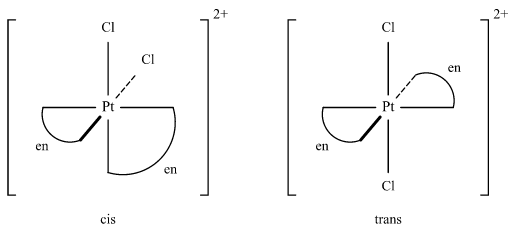 (c) In both, Ni uses hybrid orbitals (tetrahedral). In , Ni is (); is a weak field ligand and cannot pair the electrons, so two unpaired electrons remain: paramagnetic.In , Ni is in the 0 state (); CO is a strong field ligand, so the electrons are pushed into , giving with no unpaired electron: diamagnetic.(d) Linkage isomerism. Example of an ambidentate ligand: (binds through N as nitrito-N or through O as nitrito-O); others: , .
© examsnet.com
Go to Question: