Test Index
Coordination Compounds
Coordination Compounds

 CBSE Board Videos
© examsnet.com
Question : 18 of 41
Marks:
+1,
-0
The Crystal Field Theory (CFT) of coordination compounds is based on the effect of different crystal fields (provided by the ligands taken as point charges) on the degeneracy of d-orbital energies of the central metal atom/ion. The splitting of the d-orbitals provides different electronic arrangements in strong and weak crystal fields. In tetrahedral coordination entity formation, the d-orbital splitting is smaller as compared to the octahedral entity.Answer the following questions :(a) On the basis of CFT, explain why complex is coloured ? What happens on heating the complex ? Give reason. (2)[Atomic no. : Ti = 22](b) (i) What is crystal field splitting energy ? (1)OR(b) (ii) On the basis of and P (pairing energy), how can you differentiate between a strong field ligand and a weak field ligand ? (1)(c) Why are low spin tetrahedral complexes rarely observed ? (1)
[CBSE 2025 56/7/3]
Solution:
(a)In , titanium is in the state: = [Ar] . The six ligands form an octahedral field that splits the d-orbitals into a lower set and a higher set. The single electron occupies ().On absorbing visible light (blue-green, nm), this electron is promoted from to (d-d transition). The complementary colour of the unabsorbed light is seen, so the complex appears violet.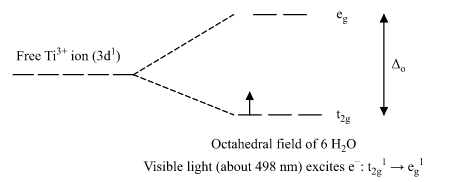 On heating: the complex loses its water ligands and becomes colourless. Without ligands there is no crystal field, so the d-orbitals are not split (they stay degenerate), no d-d transition is possible and no visible light is absorbed.(b)(i)Crystal field splitting energy is the energy difference between the two sets of d-orbitals ( and ) produced when the degenerate d-orbitals split under the influence of the ligand field. For an octahedral field it is written (for tetrahedral ).OR (b)(ii)If : the fourth electron pairs up in (, low spin); such a ligand is a strong field ligand (e.g. , CO).If : the fourth electron enters (, high spin); such a ligand is a weak field ligand (e.g. , ).(c)In a tetrahedral field the splitting is small, . This energy is almost always less than the pairing energy (), so electrons prefer to occupy the higher orbitals singly rather than pair. Hence tetrahedral complexes are high spin and low spin tetrahedral complexes are rarely observed.
© examsnet.com
Go to Question: