Test Index
Coordination Compounds
Coordination Compounds

 CBSE Board Videos
© examsnet.com
Question : 15 of 41
Marks:
+1,
-0
(a) (i) Give reasons :(I) is diamagnetic whereas is paramagnetic. [Atomic number : Ni = 28] (1)(II) CO is a stronger complexing agent than . (1)(III) The trans isomer of complex is optically inactive. (1)(ii) Using Crystal Field theory, write the number of unpaired electrons in octahedral complexes of in the presence of : (2)(I) Strong field ligand(II) Weak field ligand[Atomic number : Fe = 26]OR(b) (i) Name the type of isomerism exhibited by the following compounds. Also draw their corresponding isomers.(I) (1)(II) (1)(III) (1)(ii) Differentiate between weak field and strong field ligands. How does the strength of the ligand influence the spin of the complex ? (2)
[CBSE 2025 56/4/2]
Solution:
(a)(i)(I) In nickel is in the 0 state (). CO is a strong field ligand, so the electrons pair up into , giving ; hybridisation is (tetrahedral) with no unpaired electron, so the complex is diamagnetic.In nickel is (). is a weak field ligand and cannot pair the electrons; with hybridisation two electrons stay unpaired, so it is paramagnetic.(II) CO forms a bond by donating its lone pair to the metal and also accepts electron density from filled metal orbitals into its empty orbitals (back bonding). This synergic bonding makes the metal–carbon bond stronger. is only a donor and cannot form back bonds, so CO is the stronger complexing agent.(III) In trans- the two Cl atoms are opposite each other and both en rings lie in one plane. This plane is a plane of symmetry, so the molecule is superimposable on its mirror image and is optically inactive (only the cis isomer is chiral).(a)(ii) (): ; : .(I) Strong field ligand (): electrons pair in the lower set, configuration , 1 unpaired electron (low spin).(II) Weak field ligand (): electrons enter before pairing, configuration , 5 unpaired electrons (high spin).OR (b)(i)(I) Coordination isomerism (ligands are interchanged between the cationic and anionic complexes): and (II) Optical isomerism: exists as d and l forms, which are non-superimposable mirror images.(III) Geometrical isomerism: exists as facial (fac) and meridional (mer) isomers. In fac, the three groups occupy one face of the octahedron; in mer, they lie in one plane (around a meridian).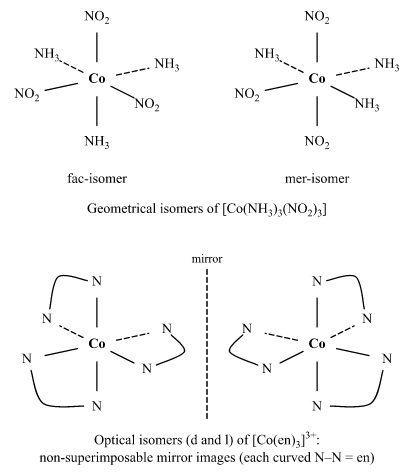 (Because is ambidentate, this complex can also show linkage isomerism: nitro, , and nitrito, .)(b)(ii)
( = pairing energy; order in the spectrochemical series: )Effect on spin (e.g. for a ion): with a weak field ligand, , so the fourth electron enters () and the complex has the maximum number of unpaired electrons: a high spin complex. With a strong field ligand, , so electrons pair in () and the complex has fewer unpaired electrons: a low spin complex.
| Weak field ligands | Strong field ligands |
| Cause small crystal field splitting () | Cause large crystal field splitting () |
| e.g. , , , , , | e.g. , CO, en, |
© examsnet.com
Go to Question: