Test Index
Biomolecules
Biomolecules

 CBSE Board Videos
© examsnet.com
Question : 13 of 49
Marks:
+1,
-0
Carbohydrates are polyhydroxy aldehydes or ketones that represent enormous structural diversity in terms of the arrangement of atoms in space, resulting in hundreds of stereoisomers. Although the chemical properties of most stereoisomers may not be very different, their metabolic rate and utilization in biological systems is significantly different and known to influence the overall carbohydrate metabolism. Structural variants, which arise due to a different arrangement of atoms in three-dimensional space are known as stereoisomers. The number of stereoisomers can be theoretically estimated by using the formula , where 'n' is the number of stereocenters or asymmetric (chiral) carbon atoms in a molecule. Out of these stereoisomers, there are some structures, which are mirror images of each other, and they are referred to as enantiomers.Answer the following questions :(a) Give chemical reactions to show the presence of an aldehydic group and straight chain in glucose. (2)(b) (i) Define anomers. (1)OR(b) (ii) Draw the structure of -D-Glucopyranose. (1)(c) Sucrose is known as invert sugar. Explain. (1)
[CBSE 2025 56/5/1]
Solution: 👈: Video Solution
(a)Aldehydic group: glucose is oxidised by a mild oxidising agent, bromine water, to gluconic acid, which has the same number of carbon atoms. Oxidation by so mild a reagent shows that the carbonyl group is an aldehyde () group. (gluconic acid)Straight chain: on prolonged heating with HI, glucose forms n-hexane, showing that all six carbon atoms are linked in a straight chain. (n-hexane)(b)(i)Anomers are the two cyclic forms of a sugar that differ only in the configuration of the group at the hemiacetal carbon C-1 (the anomeric carbon). For glucose they are -D-glucose ( at C-1 on the side opposite to the group in the Haworth structure) and -D-glucose ( at C-1 on the same side as ).OR (b)(ii)Haworth structure of -D-glucopyranose (six-membered ring of five carbons and one oxygen; at C-1 the is up, on the same side as at C-5):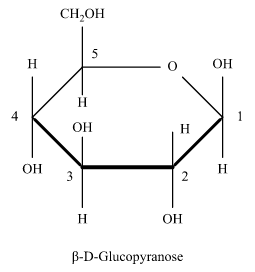 (c)Sucrose is dextrorotatory (). On hydrolysis with dilute acid or the enzyme invertase it gives an equimolar mixture of D-(+)-glucose and D-(−)-fructose:Fructose is more strongly laevorotatory () than glucose is dextrorotatory (), so the mixture is laevorotatory. Since the sign of rotation changes (inverts) from dextro (+) to laevo (−) on hydrolysis, the hydrolysis of sucrose is called inversion of sugar and the product mixture is called invert sugar.
© examsnet.com
Go to Question: