Test Index
Biomolecules
Biomolecules

 CBSE Board Videos
© examsnet.com
Question : 11 of 49
Marks:
+1,
-0
Carbohydrates are optically active polyhydroxy aldehydes or ketones or the compounds which produce such units on hydrolysis. They have been broadly classified into three groups — monosaccharides, oligosaccharides and polysaccharides. The carbohydrates may also be classified as either reducing or non-reducing sugars. An important monosaccharide glucose is an aldohexose and is correctly named as D(+)–glucose. It was assigned the open structure on the basis of its reactions with HI, , water, and nitric acid.Despite having the – CHO group, glucose does not give Schiff's test and hydrogen sulphite addition product with . It was found that glucose forms a six-membered ring in which one of the – OH groups add to the – CHO group and form a cyclic hemiacetal structure.Answer the following questions :(a) How do you explain the following ?(i) Presence of a carbonyl group in glucose(ii) Presence of five – OH groups in glucose which are attached to different carbon atoms.(b) What type of carbohydrates are called reducing sugars ?(c) (i) In D(+)–glucose, what do the letter 'D' and sign '(+)' represent ?OR(c) (ii) Draw the six-membered ring structure of –D(+)–glucose.
[CBSE 2026 56/4/2]
Solution:
(a)(i) Glucose reacts with hydroxylamine to form an oxime and adds one molecule of HCN to form a cyanohydrin. These reactions are typical of a carbonyl () group:(Mild oxidation with bromine water gives gluconic acid with the same six carbons, which shows the carbonyl group is an aldehyde group.)(a)(ii) On acetylation with acetic anhydride, glucose gives glucose pentaacetate, which shows five –OH groups:The pentaacetate is a stable compound. Two –OH groups on the same carbon would be unstable (they lose water), so the five –OH groups must be attached to five different carbon atoms.(b) Carbohydrates that reduce Fehling's solution and Tollens' reagent are called reducing sugars. They have a free (or potentially free) aldehyde or ketone group, e.g. all monosaccharides (glucose, fructose), maltose and lactose. (Sucrose, whose reducing groups are tied up in the glycosidic bond, is non-reducing.)(c)(i) 'D' denotes the configuration: the –OH group on the lowest asymmetric carbon (C-5) is on the right-hand side in the Fischer projection, as in D-(+)-glyceraldehyde. It has nothing to do with the direction of rotation.'(+)' denotes that glucose is dextrorotatory: it rotates the plane of plane-polarised light to the right (clockwise).OR (c)(ii) Ring (pyranose, Haworth) structure of -D-(+)-glucose. The C-5 –OH has added to the C-1 aldehyde group; in the -anomer the –OH on C-1 lies on the opposite side of the ring to the group (below the ring):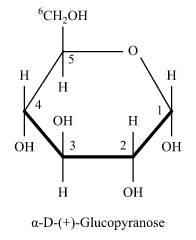
© examsnet.com
Go to Question: