Test Index
Amines
Amines

 CBSE Board Videos
© examsnet.com
Question : 44 of 46
Marks:
+1,
-0
Read the following passage and answer the questions that follow: (1+1+1+2=5)Amines constitute an important class of organic compounds derived by replacing one or more hydrogen atoms of ammonia molecule by alkyl/aryl groups. Amines are usually formed from nitro compounds, halides, amides, etc. They exhibit hydrogen bonding which influences their physical properties. Alkyl amines are found to be stronger bases than ammonia. In aromatic amines, electron releasing and withdrawing groups, respectively increase and decrease their basic character. Reactions of amines are governed by availability of the unshared pair of electrons on nitrogen. Influence of the number of hydrogen atoms at nitrogen atom on the type of reactions and nature of products is responsible for identification and distinction between primary, secondary and tertiary amines. Reactivity of aromatic amines can be controlled by acylation process.(i) Why does aniline not give Friedel-Crafts reaction? (1)(ii) Arrange the following in the increasing order of their values: (1)(iii) How can you distinguish between and by Hinsberg test? (1)(iv) (a) Write the structures of A and B in the following reactions: (2×1=2)(I)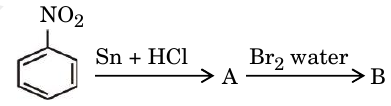 (II) OR(b) How will you convert the following: (2×1=2)(I) Benzoic acid to aniline(II) Aniline to p-bromoaniline
[CBSE 2022 56/2/2]
Solution:
(i) Friedel-Crafts reactions need anhydrous (a Lewis acid). Aniline is a Lewis base; its group donates its lone pair to and forms a salt. The nitrogen then carries a positive charge, which strongly deactivates the ring, so the reaction does not take place.(ii) A stronger base has a smaller . In aqueous solution (+I effect, solvation, steric factors), the basic strength is ( 3.29) (4.22) (4.75) (9.38; lone pair delocalised into the ring).Increasing order of : (In the gas phase, where only the +I effect counts: .)(iii) Treat each with Hinsberg's reagent (benzenesulphonyl chloride, ). (1° amine) gives N-ethylbenzenesulphonamide, , which has an acidic H on N and is soluble in alkali. (2° amine) gives N,N-diethylbenzenesulphonamide, , with no H on N; it is insoluble in alkali.(iv)(a)(I) Sn/HCl reduces the nitro group: A = aniline, . With bromine water, aniline gives a white precipitate of B = 2,4,6-tribromoaniline: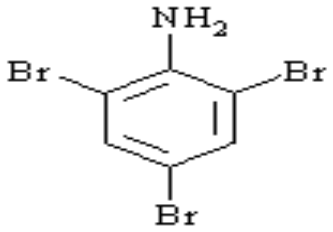 (II) Hoffmann bromamide degradation: A = ethanamine, . Acetylation in pyridine: B = N-ethylethanamide, .OR (iv)(b)(I) Benzoic acid to aniline: heat with ammonia to form benzamide, then Hoffmann bromamide degradation ( + NaOH, i.e. NaOBr).
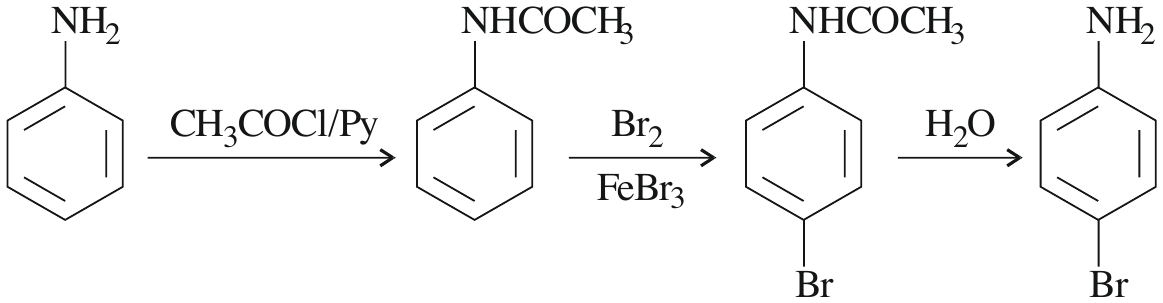
 (II) Aniline to p-bromoaniline: protect by acetylation (to stop polybromination), brominate (para product), then hydrolyse the amide.
© examsnet.com
Go to Question: