Test Index
Amines
Amines

 CBSE Board Videos
© examsnet.com
Question : 37 of 46
Marks:
+1,
-0
(a) (i) Draw the zwitter ion structure for sulphanilic acid.(ii) How can the activating effect of group in aniline be controlled ? (2 × 1 = 2)OR(b) (i) Complete the reaction with the main product formed :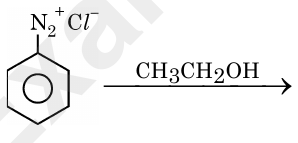 (ii) Convert Bromoethane to Propanamine. (2 × 1 = 2)
[CBSE 2023 56/5/1]
Solution:
(a)(i)Sulphanilic acid (p-aminobenzenesulphonic acid) has an acidic group and a basic group. The proton moves from to , giving the zwitter ion :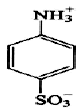 (a)(ii)By acetylation: aniline is treated with acetic anhydride (or acetyl chloride) to form acetanilide. The lone pair of N is then also in resonance with the C=O group, so it is less available to the ring and the activating effect is reduced. After the desired substitution, the acetyl group is removed by hydrolysis.OR (b)(i)Ethanol reduces the diazonium salt; the main product is benzene.(b)(ii)Bromoethane is converted to propanenitrile with KCN (one carbon added), which is then reduced to propanamine:
© examsnet.com
Go to Question: