Test Index
Amines
Amines

 CBSE Board Videos
© examsnet.com
Question : 35 of 46
Marks:
+1,
-0
The following questions are case-based questions. Read the case carefully and answer the questions that follow.Amines are usually formed from nitro compounds, halides, amides, imides, etc. They exhibit hydrogen bonding which influences their physical properties. In alkyl amines, a combination of electron releasing, steric and hydrogen bonding factors influence the stability of the substituted ammonium cations in protic polar solvents and thus affect the basic nature of amines. In aromatic amines, electron releasing and withdrawing groups, respectively increase and decrease their basic character. Influence of the number of hydrogen atoms at nitrogen atom on the type of reactions and nature of products is responsible for identification and distinction between primary, secondary and tertiary amines. Presence of amino group in aromatic ring enhances reactivity of the aromatic amines. Aryl diazonium salts provide advantageous methods for producing aryl halides, cyanides, phenols and arenes by reductive removal of the diazo group.Answer the following questions :(i) Arrange the following in the increasing order of their values in aqueous solution : (1), , (ii) Aniline on nitration gives a substantial amount of m-nitroaniline, though amino group is o/p directing. Why ? (1)(iii) An aromatic compound 'A' of molecular formula on treatment with aqueous ammonia and heating forms compound 'B'. Compound 'B' on heating with and aqueous KOH gives a compound 'C' of molecular formula . Write the structures of A, B and C. (2)OR(iii) Complete the following reactions giving main products : ()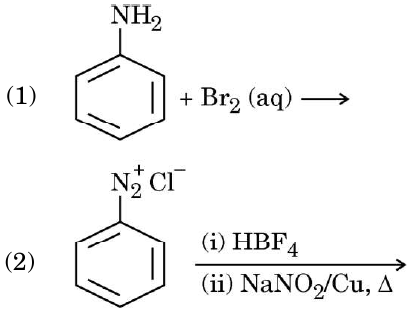
[CBSE 2023 56/4/2]
Solution:
(i) In water, basic strength: (combined effect of , solvation by hydrogen bonding and steric hindrance). A stronger base has a smaller , so the increasing order of is:(ii) Nitration is done in a strongly acidic medium. Much of the aniline is protonated to the anilinium ion . The group is electron-withdrawing and meta directing, so a substantial amount (about 47%) of m-nitroaniline is formed along with the o- and p- products.(iii) C, , is aniline. It is formed by Hoffmann bromamide degradation of B (benzamide), which is formed from A (benzoic acid, ) with ammonia.A: (benzoic acid)B: (benzamide)C: (aniline)OR (iii)(1) 2,4,6-tribromoaniline (white precipitate) (2) Main product: nitrobenzene.
© examsnet.com
Go to Question: