Test Index
Amines
Amines

 CBSE Board Videos
© examsnet.com
Question : 24 of 46
Marks:
+1,
-0
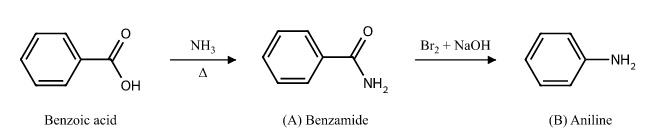
Answer any five questions of the following: (5×1=5)(a) N,N-diethyl-benzenesulphonamide is insoluble in alkali. Give reason.(b) Aniline does not undergo Friedel-Crafts reaction. Why?(c) Write a simple chemical test to distinguish between methylamine and aniline.(d) Write the chemical reaction involved in Gabriel phthalimide synthesis.(e) How will you convert aniline to p-bromoaniline?(f) Complete the following reaction: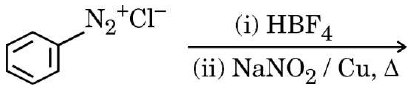 (g) Write the structures of A and B in the following reaction:
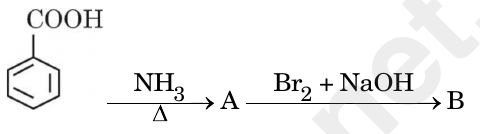
[CBSE 2024 56/1/1]
Solution:
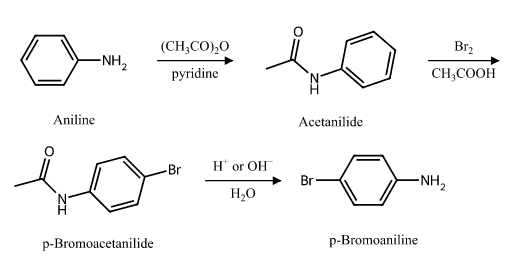
(a)In N-alkylbenzenesulphonamide (), the H on nitrogen is acidic because of the strongly electron-withdrawing sulphonyl group, so it dissolves in alkali. N,N-Diethylbenzenesulphonamide, , has no hydrogen on nitrogen, so it is not acidic and is insoluble in alkali.(b)Aniline is a Lewis base. It reacts with the Lewis acid (the catalyst) to form a salt. Nitrogen then carries a positive charge, which strongly deactivates the ring, so the Friedel-Crafts reaction does not occur.(c) Azo dye test: treat each with + dil. HCl at - and then with alkaline phenol (or -naphthol).Aniline forms benzenediazonium chloride, which couples to give an orange (or red) azo dye.Methylamine gives methanol with brisk evolution of gas and no dye.(d) Gabriel phthalimide synthesis: phthalimide with ethanolic KOH gives potassium phthalimide; heating it with an alkyl halide gives N-alkylphthalimide, which on alkaline hydrolysis gives the primary amine.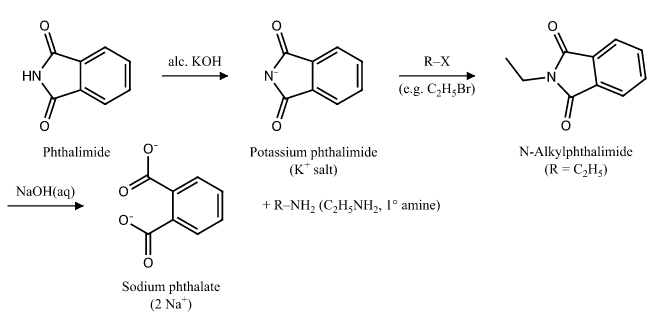 (e) Direct bromination of aniline gives 2,4,6-tribromoaniline, so the group is first protected by acetylation. Acetanilide is brominated at the para position, and hydrolysis removes the acetyl group.
 (f) The diazonium salt with fluoroboric acid gives benzenediazonium fluoroborate; heating it with aqueous in the presence of copper replaces the diazo group by :Product: nitrobenzene.(g) A = benzamide (), formed from benzoic acid and ammonia on heating. B = aniline (), formed by Hoffmann bromamide degradation:
© examsnet.com
Go to Question: