Test Index
Amines
Amines

 CBSE Board Videos
© examsnet.com
Question : 15 of 46
Marks:
+1,
-0
(a) (i) In a chemistry practical class, the teacher gave his students an amine 'X' having molecular formula , and asked the students to identify the type of amine. One of the students, Neeta, observed that it reacts with , to give a compound which dissolves in NaOH solution. Can you help Neeta to identify the compound 'X' ? (1)(ii) Arrange the following in the increasing order of their value in aqueous phase : (1), , , , (iii) Aniline on nitration gives considerable amount of meta product along with ortho and para products. Why ? (1)(iv) Convert aniline to : (2)(I) p-bromoaniline(II) phenolOR(b) (i) Arun heated a mixture of ethylamine and with ethanolic KOH, which forms a foul smelling gas. Write the chemical equation involved. (1)(ii) Identify A and B in the following reactions : (2)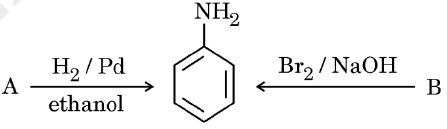 (iii) Convert aniline to : (2)(I) benzene(II) sulphanilic acid
[CBSE 2025 56/5/1]
Solution: 👈: Video Solution
(a)(i)The product with benzenesulphonyl chloride (Hinsberg's reagent) dissolves in NaOH, so it has an acidic H on N. Only a primary amine gives such a sulphonamide. The primary amine with formula is ethanamine (ethylamine), . (Its isomer is secondary and gives a sulphonamide insoluble in alkali.) (N-ethylbenzenesulphonamide, soluble in alkali)So X = (ethanamine).(a)(ii)A stronger base has a smaller . In water, basicity of the methylamines depends on the +I effect, solvation (H-bonding) of the ammonium ion and steric hindrance, giving ; aniline is the weakest base because its lone pair is delocalised into the ring.Increasing order of :(: , , , , )(a)(iii)Nitration is done in a strongly acidic medium (conc. + conc. ). There, much of the aniline is protonated to the anilinium ion, . The group is electron-withdrawing and meta-directing, so a considerable amount (about ) of m-nitroaniline is formed along with the o- and p-products from the unprotonated aniline.(a)(iv)(I) Aniline to p-bromoaniline: the group is so strongly activating that water gives 2,4,6-tribromoaniline. So the group is first protected by acetylation, then brominated, then hydrolysed: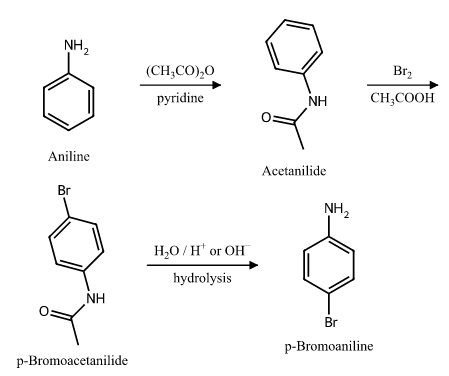 (II) Aniline to phenol: diazotisation, then warming the diazonium salt with water:OR (b)(i)Carbylamine reaction: a primary amine heated with chloroform and ethanolic KOH gives a foul-smelling isocyanide (carbylamine). (ethyl isocyanide)(b)(ii)A = nitrobenzene, : catalytic hydrogenation (/Pd in ethanol) reduces to .B = benzamide, : Hofmann bromamide degradation (/NaOH) gives an amine with one carbon less.(b)(iii)(I) Aniline to benzene: diazotise, then reduce the diazonium salt with hypophosphorous acid:(II) Aniline to sulphanilic acid: aniline reacts with conc. to form anilinium hydrogensulphate, which on heating at gives p-aminobenzenesulphonic acid (sulphanilic acid): (sulphanilic acid)
© examsnet.com
Go to Question: