Test Index
Aldehydes, Ketones and Carboxylic Acids
Aldehydes, Ketones and Carboxylic Acids

 CBSE Board Videos
© examsnet.com
Question : 36 of 45
Marks:
+1,
-0
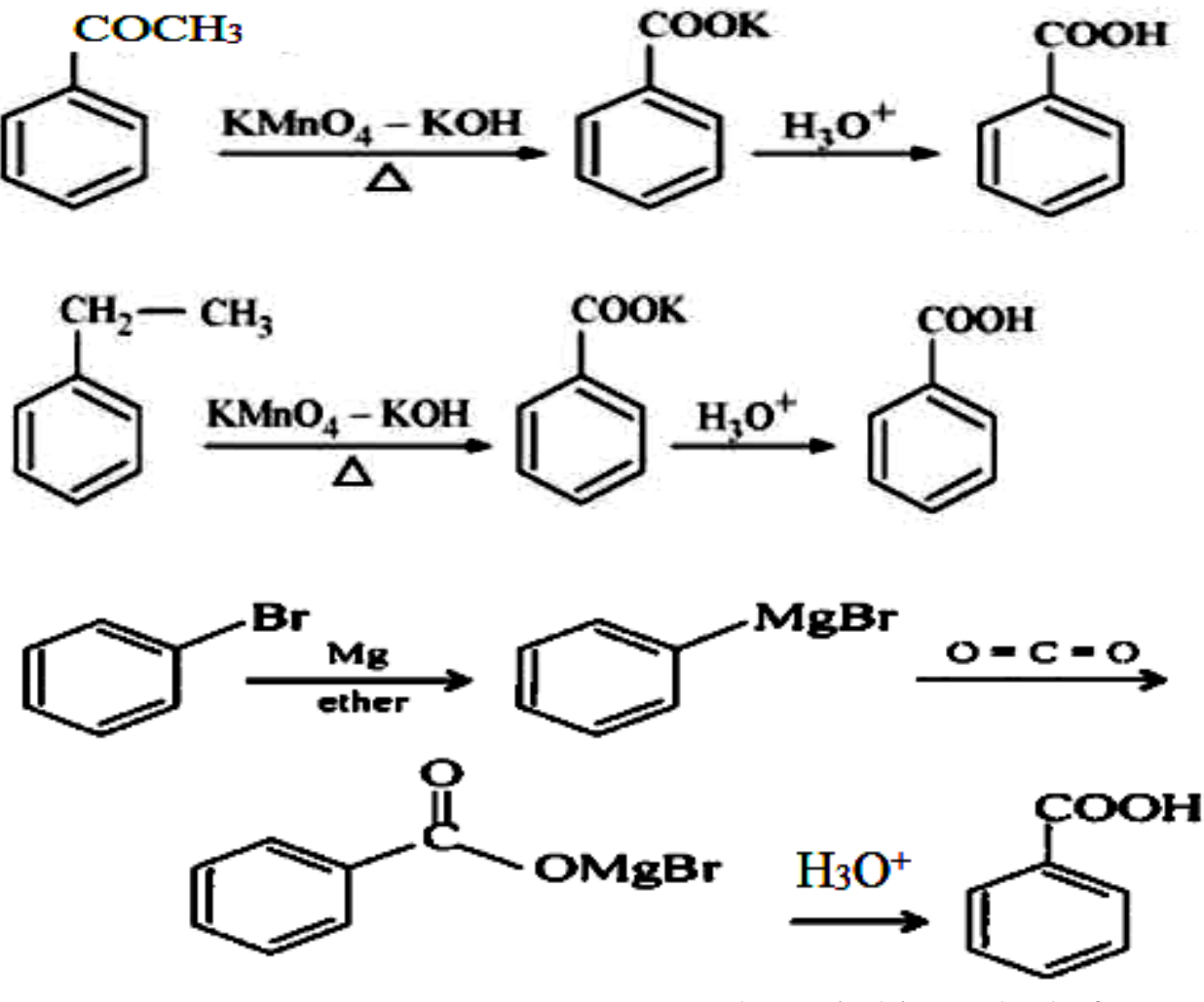
(a) (i) An organic compound (X) having molecular formula can show various properties depending on its structures. Draw each of the structures if it(1) gives positive iodoform test.(2) shows Cannizzaro's reaction.(3) reduces Tollens' reagent and has a chiral carbon.(ii) Write the reaction involved in the following :(1) Wolff-Kishner reduction(2) Hell-Volhard-Zelinsky reaction (3 + 2 = 5)OR(b) (i) How can you convert each of the following compounds to Benzoic acid ?(1) Acetophenone(2) Ethylbenzene(3) Bromobenzene(ii) Arrange the following compounds in increasing order of their property as indicated :(1) , , (Acidic character)(2) Ethanal, Propanal, Butanone, Propanone (Reactivity in nucleophilic addition reactions) (3 + 2 = 5)
[CBSE 2023 56/3/1]
Solution:
(a)(i) is a saturated aldehyde or ketone.(1) Positive iodoform test needs a group: (pentan-2-one); [3-methylbutan-2-one, , also fits].(2) Cannizzaro reaction needs an aldehyde with no -H: (2,2-dimethylpropanal).(3) Reduces Tollens' reagent (aldehyde) and has a chiral carbon: (2-methylbutanal); carries H, , and CHO.(a)(ii)(1) Wolff–Kishner reduction: the carbonyl group is converted into by hydrazine, then KOH in ethylene glycol on heating: (a)(ii)(2) Hell–Volhard–Zelinsky reaction: a carboxylic acid with an -H is halogenated at the -carbon by or with red phosphorus:
 OR (b)(i) The three conversions, in order (1) acetophenone, (2) ethylbenzene, (3) bromobenzene:(1) and (2): the whole side chain is oxidised by alkaline to , which acidification turns into .(3): Grignard reagent, then carbon dioxide (dry ice), then acid hydrolysis.
 OR (b)(ii)(1) Acidic character increases with the electron-withdrawing power of the group on the -carbon ():(2) Reactivity in nucleophilic addition falls as more and larger alkyl groups are attached (+I effect and steric hindrance):Butanone Propanone Propanal Ethanal
© examsnet.com
Go to Question: