Test Index
Aldehydes, Ketones and Carboxylic Acids
Aldehydes, Ketones and Carboxylic Acids

 CBSE Board Videos
© examsnet.com
Question : 30 of 45
Marks:
+1,
-0
(a) Draw structure of the 2,4-dinitrophenylhydrazone of benzaldehyde.(b) Which acid of the following pair is a stronger acid ? (c) Write the chemical equation involved in Rosenmund's reduction.(d) Why are -hydrogen atoms of aldehydes and ketones acidic in nature ?(e) Write a chemical test to distinguish between Benzaldehyde and Benzoic acid. ()
[CBSE 2023 56/4/2]
Solution:
(a) Benzaldehyde condenses with 2,4-dinitrophenylhydrazine (loss of water) to give benzaldehyde 2,4-dinitrophenylhydrazone, :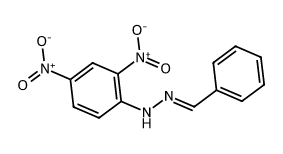 (b) 4-(Trifluoromethyl)benzoic acid, , is the stronger acid. is strongly electron-withdrawing (), so it stabilises the carboxylate ion; is electron-releasing () and destabilises it.(c) Rosenmund reduction: an acyl chloride is hydrogenated over palladium on barium sulphate (poisoned catalyst) to an aldehyde:(d) The -hydrogens are acidic because of the strong electron-withdrawing effect of the carbonyl group, and because the conjugate base (enolate ion) formed on losing an -H is stabilised by resonance (the negative charge is shared with the carbonyl oxygen).(e) Sodium bicarbonate test: benzoic acid gives brisk effervescence of with solution, benzaldehyde does not.(Also: benzaldehyde gives a silver mirror with Tollens' reagent, benzoic acid does not.)
© examsnet.com
Go to Question: