Test Index
Aldehydes, Ketones and Carboxylic Acids
Aldehydes, Ketones and Carboxylic Acids

 CBSE Board Videos
© examsnet.com
Question : 26 of 45
Marks:
+1,
-0
(a) (i) Write the major product(s) in the following reactions:(1) (2)
 (3)
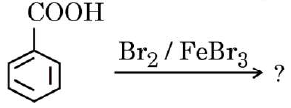 (ii) Give simple chemical tests to distinguish between the following pairs of compounds:(1)
 (2) Pentanal and Pentan-3-one (3 + 2 = 5)OR(b) (i) Give reasons for the following:(1) In semicarbazide, only one group is involved in the formation of semicarbazone.(2) Acetaldehyde is more reactive than acetone towards addition of HCN.(ii) (1) Arrange the following in decreasing order of their acidic strength:, , (2) Name the reagent in the following reaction:(iii) Write the reaction involved in Hell-Volhard-Zelinsky reaction. (2 + 2 + 1 = 5)
[CBSE 2024 56/3/1]
Solution:
(a)(i)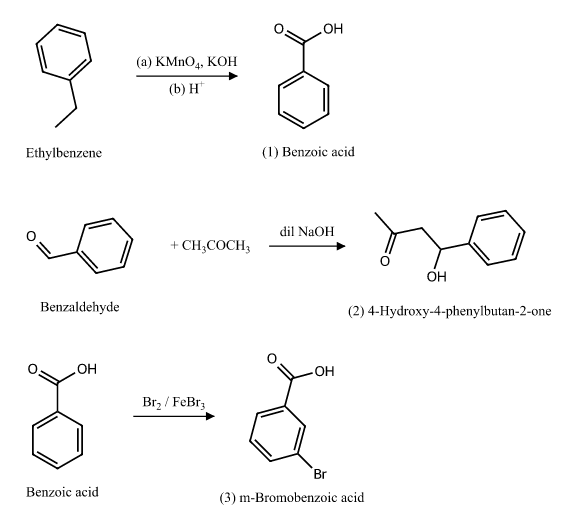 (1) Benzoic acid, : alkaline oxidises the whole alkyl side chain (having a benzylic H) to ; acid gives the free acid.(2) (4-hydroxy-4-phenylbutan-2-one): cross aldol reaction; the carbanion from acetone (which has -H) adds to the carbonyl of benzaldehyde (no -H). On warming it loses water to give benzalacetone, (Claisen-Schmidt condensation).(3) m-Bromobenzoic acid: is an electron-withdrawing, deactivating and meta-directing group.(a)(ii)(1) Iodoform test: warm each with and NaOH. Acetophenone (, has a group) gives a yellow precipitate of iodoform (); propiophenone () does not.(a)(ii)(2) Tollens' test: warm with Tollens' reagent. Pentanal (an aldehyde) gives a silver mirror; pentan-3-one (a ketone) does not. (Fehling's solution also works: pentanal gives a red-brown precipitate.)OR (b)(i)(1) Semicarbazide is . The lone pairs on the two nitrogens next to the group are delocalised into the carbonyl group by resonance, so they are not available for attack. Only the terminal attached to (not to ) is nucleophilic and forms the semicarbazone.(b)(i)(2) Acetaldehyde () has one alkyl group while acetone () has two. Electronic: two alkyl groups reduce the positive charge (electrophilicity) on the carbonyl carbon of acetone more. Steric: two methyl groups hinder the approach of the nucleophile more. So acetaldehyde adds HCN faster.(b)(ii)(1) ( is strongly electron-withdrawing () and stabilises the carboxylate ion; is electron-releasing () and destabilises it.)(b)(ii)(2) Reagent: (i) DIBAL-H (diisobutylaluminium hydride), (ii) . It reduces the nitrile to the aldehyde without reducing the double bond.(b)(iii) Hell-Volhard-Zelinsky reaction: a carboxylic acid with an -hydrogen is halogenated at the -carbon by chlorine or bromine in the presence of red phosphorus: ()e.g.
© examsnet.com
Go to Question: