Test Index
Aldehydes, Ketones and Carboxylic Acids
Aldehydes, Ketones and Carboxylic Acids

 CBSE Board Videos
© examsnet.com
Question : 24 of 45
Marks:
+1,
-0
(a) (i) Account for the following :(1) Oxidation of aldehydes is easier as compared to ketones.(2) The alpha hydrogen atoms of aldehydes are acidic in nature.(ii) Write the products in the following reactions :(1)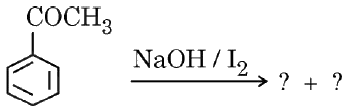 (2)
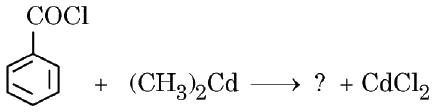 (iii) Give a simple chemical test to distinguish between ethanoic acid and ethanal. (2+2+1)OR(b) (i) Draw structure of the 2,4-dinitrophenylhydrazone of benzaldehyde.(ii) Arrange the following in increasing order of their reactivity towards HCN :, , (iii) How can you convert phenyl magnesium bromide to benzoic acid ?(iv) Give a simple chemical test to distinguish between benzaldehyde and ethanal.(v) Write the main product in the following reaction : (5 1)
[CBSE 2024 56/2/2]
Solution:
(a)(i)(1)Aldehydes have a hydrogen atom on the carbonyl carbon. Their oxidation to acids involves breaking this C–H bond, which is easy, so even mild oxidising agents (Tollens' reagent, Fehling's solution) oxidise aldehydes. Ketones have no such H; their oxidation needs cleavage of a stronger C–C bond, which requires strong oxidising agents and drastic conditions.(a)(i)(2)The carbonyl group is strongly electron-withdrawing, so the C–H bond at the -carbon is weakened. Also, the carbanion (enolate ion) formed on losing the -hydrogen is stabilised by resonance, the negative charge being delocalised onto the carbonyl oxygen:Hence the -hydrogens are acidic.(a)(ii)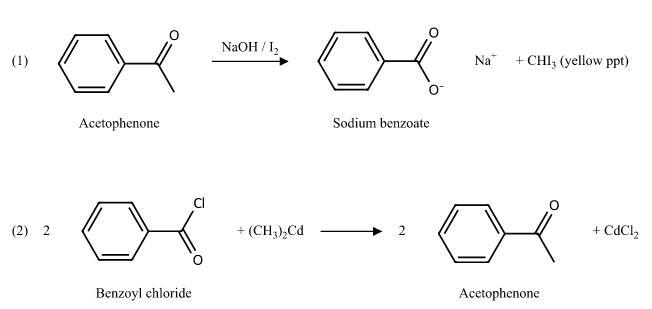 (1) Acetophenone is a methyl ketone, so it gives the haloform (iodoform) reaction: products are sodium benzoate, , and iodoform, .(2) Acyl chlorides react with dialkylcadmium to give ketones: the product is acetophenone, .(a)(iii)Add sodium hydrogencarbonate solution: ethanoic acid gives brisk effervescence of ; ethanal does not.(Or: ethanal gives a silver mirror with Tollens' reagent, or a yellow precipitate of iodoform with NaOH/; ethanoic acid does not.)OR (b)(i)Benzaldehyde condenses with 2,4-dinitrophenylhydrazine (loss of water) to give the 2,4-DNP derivative, :
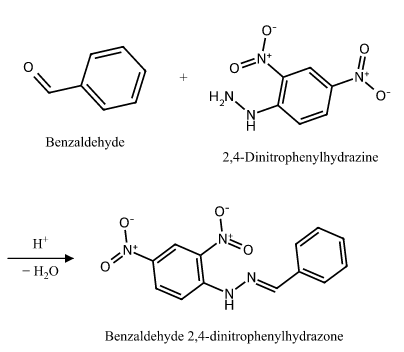 OR (b)(ii)Reactivity towards nucleophilic addition of HCN decreases with increasing steric hindrance and electron release (+I effect) by alkyl groups at the carbonyl carbon:OR (b)(iii)Phenylmagnesium bromide reacts with dry ice () in dry ether, and the adduct is hydrolysed with dilute acid:OR (b)(iv)Iodoform test: on warming with NaOH and , ethanal (, has a group) gives a yellow precipitate of iodoform; benzaldehyde does not.(Or: ethanal gives a red-brown precipitate with Fehling's solution; benzaldehyde does not.)OR (b)(v) reduces the ketone group but not the ester group:Product: ethyl 3-hydroxybutanoate.
© examsnet.com
Go to Question: