Test Index
Aldehydes, Ketones and Carboxylic Acids
Aldehydes, Ketones and Carboxylic Acids

 CBSE Board Videos
© examsnet.com
Question : 17 of 45
Marks:
+1,
-0
(a) (i) An organic compound (X) having molecular formula can show various properties depending on its structures. Draw each of the structures if it :(I) shows Cannizzaro reaction. (1)(II) reduces Tollens' reagent and has a chiral carbon. (1)(III) gives positive iodoform test. (1)(ii) Write the reaction involved in the following : (2)(I) Clemmensen reduction(II) Etard reactionOR(b) Answer the following questions : (5 × 1 = 5)(i) Draw structure of the methyl hemiacetal of methanal.(ii) There are two groups in semicarbazide. However only one is involved in the formation of semicarbazones. Give reason.(iii) How will you convert ethanol to 3-hydroxybutanal ?(iv) Complete the following equation :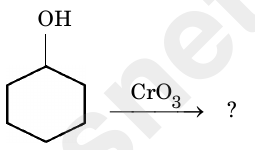 (v) Write the final product formed when phthalic acid is treated with followed by strong heating.
[CBSE 2025 56/7/3]
Solution:
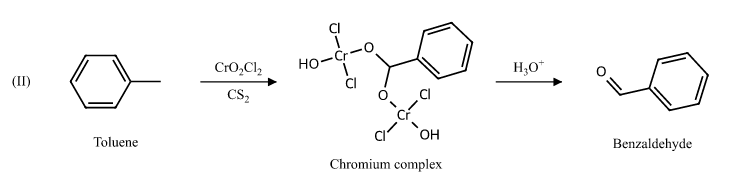
(a)(i)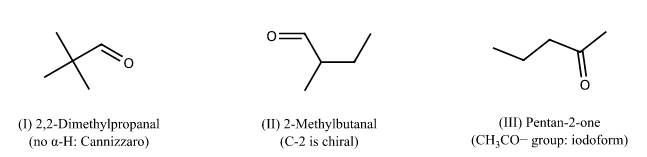 (I) Cannizzaro reaction needs an aldehyde with no -hydrogen: 2,2-dimethylpropanal, .(II) Reducing Tollens' reagent means an aldehyde; a chiral carbon (four different groups) is present in 2-methylbutanal, .(III) A positive iodoform test needs a group: pentan-2-one, (3-methylbutan-2-one, , also fits).(a)(ii)(I) Clemmensen reduction: the carbonyl group of an aldehyde or ketone is reduced to by zinc amalgam and concentrated HCl.e.g. (II) Etard reaction: toluene is oxidised by chromyl chloride in to a chromium complex, which on hydrolysis gives benzaldehyde.
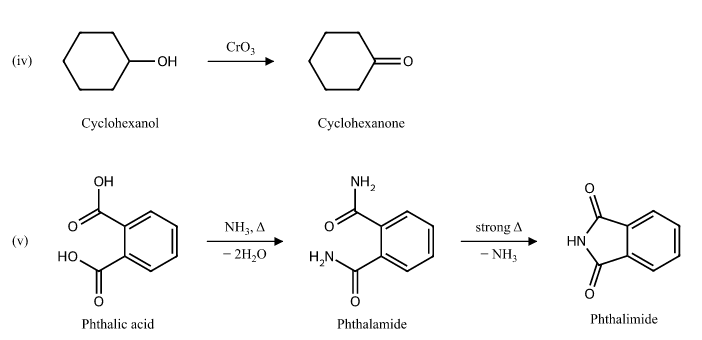
 OR (b)(i) Methanal + methanol (dry HCl) gives the hemiacetal methoxymethanol: , i.e. .(ii) Semicarbazide is . The lone pair of the attached to the group is delocalised onto the carbonyl oxygen by resonance (), so it is not nucleophilic. Only the terminal (on the NH) keeps a free lone pair and attacks the carbonyl carbon to form the semicarbazone.(iii) Oxidise ethanol to ethanal, then carry out aldol condensation (addition) with dilute alkali: (3-hydroxybutanal)(iv) oxidises the secondary alcohol cyclohexanol to the ketone cyclohexanone.(v) Phthalic acid with forms ammonium phthalate, which on heating gives phthalamide; on strong heating phthalamide loses ammonia and the final product is phthalimide.
© examsnet.com
Go to Question: