Test Index
Aldehydes, Ketones and Carboxylic Acids
Aldehydes, Ketones and Carboxylic Acids

 CBSE Board Videos
© examsnet.com
Question : 15 of 45
Marks:
+1,
-0
(a) (i) Complete the following reactions by writing the structure of the main products :(I) (1) (II) (1)(III) (1)
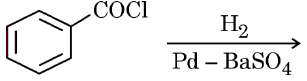 (ii) Give simple chemical test to distinguish between the following pairs of compounds :(I) Ethyl benzoate and benzoic acid (1)(II) Propanal and propanone (1)OR(b) (i) Complete each synthesis by giving missing starting material, reagent or products :(I) (1)
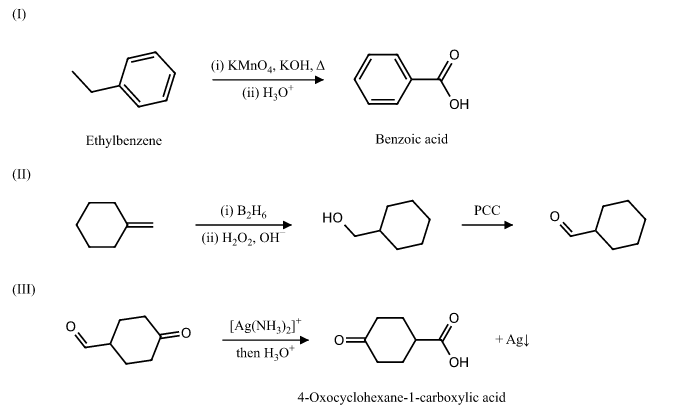
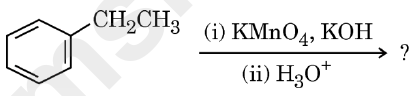 (II) (1)
 (III) (1)
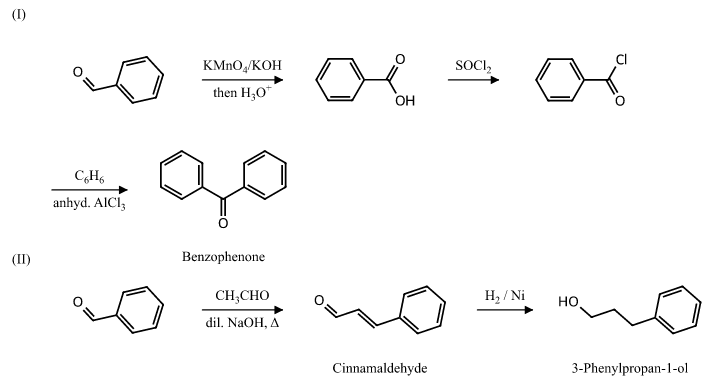
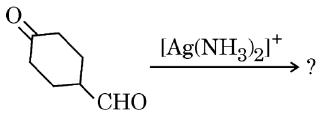 (ii) Carry out the following conversions :(I) Benzaldehyde to Benzophenone (1)(II) Benzaldehyde to 3-phenyl propanol (1)
[CBSE 2025 56/4/2]
Solution:
(a)(i)(I) Semicarbazide adds to the carbonyl group and water is lost (addition–elimination), giving cyclohexanone semicarbazone, .(II) Dialkylcadmium converts an acyl chloride into a ketone: (product: propanone)(III) Rosenmund reduction: hydrogen over palladium poisoned with reduces the acid chloride only up to the aldehyde, giving benzaldehyde, (+ HCl).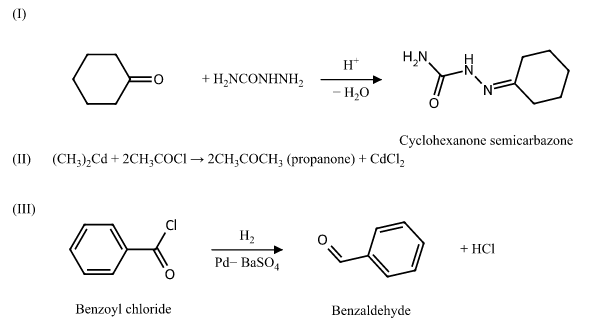 (a)(ii)(I) Sodium hydrogencarbonate test: add aqueous to each. Benzoic acid gives brisk effervescence of ; ethyl benzoate (an ester) does not.(II) Tollens' test: warm each with Tollens' reagent (ammoniacal silver nitrate). Propanal (an aldehyde) gives a silver mirror; propanone does not.(Alternatively, the iodoform test: propanone, a methyl ketone, gives a yellow precipitate of with ; propanal does not.)OR (b)(i)(I) Alkaline oxidises the whole side chain of an alkylbenzene to (as the potassium salt), and acidification gives benzoic acid, .(II) Missing reagents: (i) , (ii) / (hydroboration–oxidation, anti-Markovnikov addition of water) gives cyclohexylmethanol, which is then oxidised with PCC to cyclohexanecarbaldehyde.(III) Tollens' reagent is a mild oxidising agent: it oxidises only the group and leaves the ring ketone untouched. The product is 4-oxocyclohexane-1-carboxylate, which on acidification gives 4-oxocyclohexane-1-carboxylic acid (with a silver mirror).
 (b)(ii)(I) Benzaldehyde to benzophenone:(the last step is Friedel–Crafts acylation of benzene).(II) Benzaldehyde to 3-phenylpropan-1-ol:Cross aldol condensation gives cinnamaldehyde; catalytic hydrogenation reduces both the C=C and the CHO group.
© examsnet.com
Go to Question: