Test Index
Alcohols, Phenols and Ethers
Alcohols, Phenols and Ethers

 CBSE Board Videos
© examsnet.com
Question : 9 of 45
Marks:
+1,
-0
Alcohols and Phenols are acidic in nature. Electron withdrawing groups in phenol increase its acidic strength and electron releasing groups decrease it. Alcohols undergo nucleophilic substitution with hydrogen halides to yield alkyl halides. Dehydration of alcohols gives alkenes. On oxidation, primary alcohols yield aldehydes with mild oxidising agents and carboxylic acids with strong oxidising agents, while secondary alcohols yield ketones. Tertiary alcohols are resistant to oxidation. The presence of – OH group in phenols activates the aromatic ring towards electrophilic substitution and directs the incoming group to ortho and para positions due to resonance effect.Answer the following questions :(a) Write the mechanism of acid dehydration of ethanol to yield ethene.(b) (i) Why are tertiary alcohols resistant to oxidation ?OR(b) (ii) Write the structure of the major product expected from the dinitration of 3-methylphenol.(c) Why is ortho-nitrophenol more acidic than ortho-methoxyphenol ?
[CBSE 2026 56/4/2]
Solution:
(a) Ethanol is heated with conc. at :The mechanism has three steps.Step 1: Protonation of the alcohol (fast). The lone pair on oxygen takes up to form the ethyloxonium ion:Step 2: Formation of the carbocation (slow, rate-determining). Water, a good leaving group, departs:Step 3: Loss of a proton (elimination). A proton is lost from the carbon next to the positive carbon, giving the double bond:The used in step 1 is given back, so the acid acts as a catalyst; the ethene formed is removed from the mixture, which drives the equilibrium forward.(b)(i) Oxidation of an alcohol is a dehydrogenation: the H of the –OH group and a hydrogen on the carbon carrying the –OH group (-hydrogen) are removed to form . A tertiary alcohol has no hydrogen on this carbon, so it cannot form a group without breaking a C–C bond. Hence tertiary alcohols resist oxidation under normal conditions (only drastic conditions break them into smaller acids).OR (b)(ii) In 3-methylphenol both groups are activating and ortho/para-directing. The –OH group (strong +R effect) directs to C-2, C-4 and C-6; the group at C-3 also directs to C-2, C-4 and C-6. C-2 lies between the two groups and is sterically hindered, so the two nitro groups enter C-4 and C-6.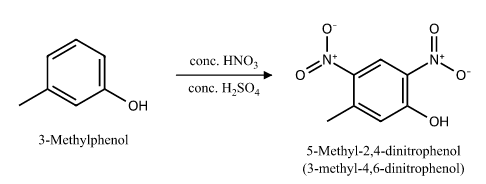 Major product: 3-methyl-4,6-dinitrophenol (IUPAC name: 5-methyl-2,4-dinitrophenol).(c) The acidity of a phenol depends on the stability of its phenoxide ion.In o-nitrophenol the group is electron-withdrawing ( and effects). It spreads out the negative charge of the o-nitrophenoxide ion and stabilises it, so the O–H proton is released easily.In o-methoxyphenol the group is electron-releasing ( effect). It increases the negative charge on the phenoxide oxygen and destabilises the ion, so the proton is released less easily.Hence o-nitrophenol () is more acidic than o-methoxyphenol ().
© examsnet.com
Go to Question: