Test Index
Alcohols, Phenols and Ethers
Alcohols, Phenols and Ethers

 CBSE Board Videos
© examsnet.com
Question : 6 of 45
Marks:
+1,
-0
Ethers are prepared by the dehydration of alcohols in presence of protic acids at . Symmetrical and unsymmetrical ethers can also be prepared by Williamson synthesis. This reaction involves attack of an alkoxide ion on primary alkyl halide. If a tertiary alkyl halide is used, elimination reaction occurs and an alkene is formed, no ether is formed. bond in ethers are cleaved under drastic conditions with excess of HI. When unsymmetrical ethers react with HI, the alkyl halide is formed from smaller alkyl group. If one of the alkyl group is tertiary, the alkyl halide is formed from the tertiary alkyl group because tertiary alkyl carbocation is more stable than the primary carbocation. Cleavage of alkyl aryl ethers takes place at the alkyl-oxygen bond due to more stable aryl-oxygen bond. The order of reactivity of hydrogen halides is . Aromatic ethers undergo electrophilic substitution reactions. The alkoxy group attached to the aromatic ring activates the ring towards electrophilic substitution and directs the incoming group to ortho- and para positions.Answer the following questions :(a) Complete the following equations : (2)(i)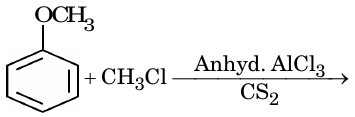 (ii)
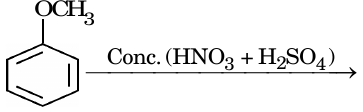 (b) (i) Write the names of alkyl halide and sodium alkoxide used to prepare tert-butyl ethyl ether. (1)OR(b) (ii) Anisole on reaction with HI gives phenol and and not methanol and iodobenzene. Justify the statement. (1)(c) Why is bond angle in ethers slightly greater than tetrahedral angle ? (1)
[CBSE 2026 56/5/3]
Solution:
(a)The group is an activating, ortho/para-directing group ( effect of the oxygen lone pair), so both reactions give a mixture of the ortho and para products. The para product is the major one because the bulky group hinders attack at the ortho position.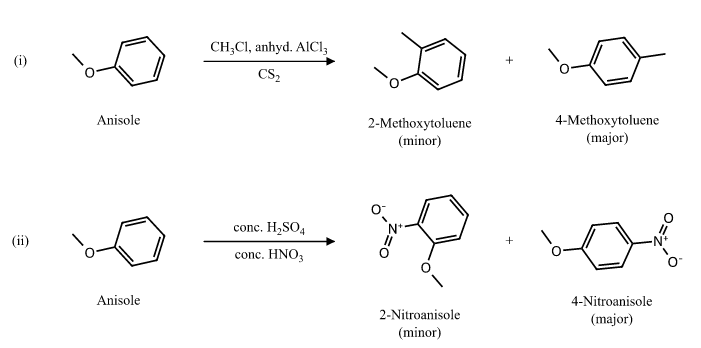 (i) Friedel-Crafts alkylation: 2-methoxytoluene (minor) + 4-methoxytoluene (major) + (ii) Nitration: 2-nitroanisole (minor) + 4-nitroanisole (major)(b)(i)Alkyl halide: bromoethane (ethyl bromide), Sodium alkoxide: sodium tert-butoxide, The halide must be primary: with tert-butyl bromide and sodium ethoxide, elimination would give 2-methylpropene instead of the ether.OR (b)(ii)The ether is first protonated. The bond is stronger than the bond because it has partial double bond character (resonance of the oxygen lone pair with the ring, carbon). So the iodide ion attacks the less hindered methyl carbon () and breaks the bond. The carbon of the benzene ring does not undergo nucleophilic substitution, so iodobenzene and methanol are not formed.(c)In ethers the oxygen is hybridised, but the angle is about , slightly more than the tetrahedral angle (). This is due to the repulsive interaction between the two bulky alkyl groups attached to the oxygen, which pushes them apart and opens up the angle.
© examsnet.com
Go to Question: