Test Index

Alcohols, Phenols and Ethers Get it on Google PlayDownload on the App Store CBSE Board Videos

© examsnet.com
Question : 33 of 45
Marks: +1, -0
(a) (i) Write hydroboration-oxidation reaction with an example.
(ii) Write the products of the following reaction :
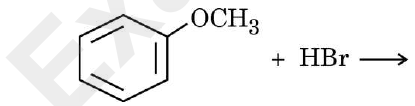
(iii) Why is p-nitrophenol more acidic than phenol ? (3×1=33 \times 1 = 3)
OR
(b) (i) What happens when phenol reacts with
(1) Conc. HNO3\text{HNO}_3, and
(2) CHCl3\text{CHCl}_3 in presence of aqueous NaOH followed by acidification ?
Write equations only.
(ii) Why does the reaction of CH3ONa\text{CH}_3\text{ONa} with (CH3)3C−Br(\text{CH}_3)_3\text{C}-\text{Br} give 2-methylpropene and not (CH3)3C−OCH3(\text{CH}_3)_3\text{C}-\text{OCH}_3 ? (2+1=32 + 1 = 3)
[CBSE 2023 56/4/2]
Solution:  
(a)(i) Hydroboration-oxidation: diborane adds to an alkene to form a trialkylborane, which is oxidised by alkaline H2O2\text{H}_2\text{O}_2 to an alcohol. The net result is addition of water against Markovnikov's rule. Example, propene to propan-1-ol:
3 CH3CH=CH2+(BH3)2→(CH3CH2CH2)3B3\,\text{CH}_3\text{CH=CH}_2 + \text{(BH}_3)_2 \rightarrow (\text{CH}_3\text{CH}_2\text{CH}_2)_3\text{B}
(CH3CH2CH2)3B+3H2O2→OH−3 CH3CH2CH2OH+B(OH)3(\text{CH}_3\text{CH}_2\text{CH}_2)_3\text{B} + 3\text{H}_2\text{O}_2 \xrightarrow{\text{OH}^-} 3\,\text{CH}_3\text{CH}_2\text{CH}_2\text{OH} + \text{B(OH)}_3
(a)(ii) C6H5–O–CH3+HBr→C6H5OH+CH3Br\text{C}_6\text{H}_5\text{–O–CH}_3 + \text{HBr} \rightarrow \text{C}_6\text{H}_5\text{OH} + \text{CH}_3\text{Br}
Products: phenol and methyl bromide. The O–C6H5\text{O–C}_6\text{H}_5 bond has partial double bond character, so Br−\text{Br}^- attacks the methyl carbon (SN2\text{S}_\text{N}2) and the O–CH3\text{O–CH}_3 bond breaks.
(a)(iii) –NO2\text{–NO}_2 is an electron-withdrawing group (−I-I and −R-R effects). In p-nitrophenoxide ion the negative charge is delocalised onto the –NO2\text{–NO}_2 group as well, so this ion is more stable than the phenoxide ion. A more stable conjugate base means a stronger acid, so p-nitrophenol is more acidic than phenol.
OR (b)
(b)(i)(1) With conc. HNO3\text{HNO}_3 phenol gives 2,4,6-trinitrophenol (picric acid):
C6H5OH+3 HNO3→conc. H2SO4C6H2(NO2)3OH+3 H2O\text{C}_6\text{H}_5\text{OH} + 3\,\text{HNO}_3 \xrightarrow{\text{conc. H}_2\text{SO}_4} \text{C}_6\text{H}_2(\text{NO}_2)_3\text{OH} + 3\,\text{H}_2\text{O}
(b)(i)(2) Reimer–Tiemann reaction gives salicylaldehyde (2-hydroxybenzaldehyde):
C6H5OH→CHCl3+aq. NaOHo-C6H4(ONa)CHO→H+o-C6H4(OH)CHO\text{C}_6\text{H}_5\text{OH} \xrightarrow{\text{CHCl}_3 + \text{aq. NaOH}} o\text{-C}_6\text{H}_4(\text{ONa})\text{CHO} \xrightarrow{\text{H}^+} o\text{-C}_6\text{H}_4(\text{OH})\text{CHO}
(b)(ii) CH3ONa\text{CH}_3\text{ONa} is a strong base as well as a nucleophile, and (CH3)3C–Br(\text{CH}_3)_3\text{C–Br} is a tertiary halide. The bulky tertiary carbon hinders SN2\text{S}_\text{N}2 attack, so the methoxide removes a β\beta-hydrogen instead and elimination takes place:
(CH3)3C–Br+CH3ONa→(CH3)2C=CH2+CH3OH+NaBr(\text{CH}_3)_3\text{C–Br} + \text{CH}_3\text{ONa} \rightarrow (\text{CH}_3)_2\text{C=CH}_2 + \text{CH}_3\text{OH} + \text{NaBr}
To prepare (CH3)3C–OCH3(\text{CH}_3)_3\text{C–OCH}_3, use (CH3)3C–ONa+CH3Br(\text{CH}_3)_3\text{C–ONa} + \text{CH}_3\text{Br} instead.
© examsnet.com
Advertisements
Go to Question:

