Test Index

Alcohols, Phenols and Ethers Get it on Google PlayDownload on the App Store CBSE Board Videos

© examsnet.com
Question : 23 of 45
Marks: +1, -0
(a) Write the mechanism of the following reaction:
CH3CH2OH→443 KH+CH2=CH2\text{CH}_3\text{CH}_2\text{OH} \xrightarrow[443 \text{ K}]{\text{H}^+} \text{CH}_2=\text{CH}_2
(b) Write the main product in each of the following reactions:
(i) CH3−CH2−CH=CH2→b) 3H2O2/OH−a) B2H6\text{CH}_3-\text{CH}_2-\text{CH}=\text{CH}_2 \xrightarrow[\text{b) } 3\text{H}_2\text{O}_2/\text{OH}^-]{\text{a) B}_2\text{H}_6}
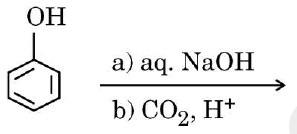
(ii)
(1+2=3)
[CBSE 2024 56/1/1]
Solution:  
(a) Acid-catalysed dehydration of ethanol at 443 K443 \text{ K}:
Step 1: Formation of protonated alcohol (fast)
CH3CH2−O¨−H+H+⇌CH3CH2−O+H2\text{CH}_3\text{CH}_2-\ddot{\text{O}}-\text{H} + \text{H}^+ \rightleftharpoons \text{CH}_3\text{CH}_2-\overset{+}{\text{O}}\text{H}_2 (ethyl oxonium ion)
Step 2: Formation of carbocation (slow, rate-determining)
CH3CH2−O+H2⇌CH3−C+H2+H2O\text{CH}_3\text{CH}_2-\overset{+}{\text{O}}\text{H}_2 \rightleftharpoons \text{CH}_3-\overset{+}{\text{C}}\text{H}_2 + \text{H}_2\text{O}
Step 3: Formation of ethene by loss of a proton
H−CH2−C+H2⇌CH2=CH2+H+\text{H}-\text{CH}_2-\overset{+}{\text{C}}\text{H}_2 \rightleftharpoons \text{CH}_2=\text{CH}_2 + \text{H}^+
The H+\text{H}^+ released in step 3 is used again, so the acid acts as a catalyst.
(b)(i) Hydroboration-oxidation adds water against Markovnikov's rule (OH goes to the terminal carbon):
CH3CH2CH=CH2→(b) H2O2/OH−(a) B2H6CH3−CH2−CH2−CH2−OH\text{CH}_3\text{CH}_2\text{CH}=\text{CH}_2 \xrightarrow[\text{(b) } \text{H}_2\text{O}_2/\text{OH}^-]{\text{(a) } \text{B}_2\text{H}_6} \text{CH}_3-\text{CH}_2-\text{CH}_2-\text{CH}_2-\text{OH} (butan-1-ol)
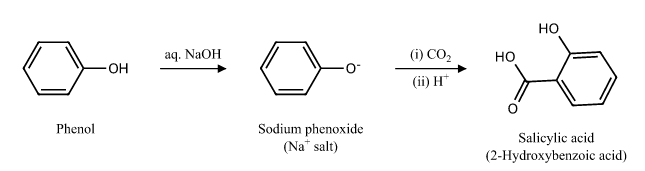
(b)(ii) Kolbe's reaction: phenol with NaOH gives sodium phenoxide; the phenoxide ion (more reactive than phenol) undergoes electrophilic substitution with CO2\text{CO}_2 at the ortho position, and acidification gives salicylic acid (2-hydroxybenzoic acid).
© examsnet.com
Advertisements
Go to Question: