Test Index
CBSE Class 12 Chemistry 2022 Term 2 Delhi Set 1
© examsnet.com
Question : 11 of 12
Marks:
+1,
-0
(a) Complete the following: (i) ' (ii) Write IUPAC name of the following compound: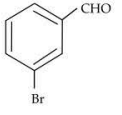 (iii)Write a chemical test to distinguish between the following compounds: Phenol and Benzoic acid OR (b) Convert the following: (i) Benzoic acid to Benzaldehyde (ii) Propan-1-ol to 2-Bromopropanoic acid (iii) Acetaldehyde to But-2-enal
Solution:
(a) (i) A-Acetaldehyde B-Acetaloxide (ii) The IUPAC name is 3-bromobenzaldehyde. (iii) Phenol and Benzoic Acid can be distinguished by iron chloride test. As phenol gives violet colouration with neutral solution while benzoic acid gives buff coloured precipitate of ferric benzoate. Violet complex OR (b) (i) Benzoic acid to benzaldehyde - Firstly benzoic acid is converted into benzoyl chloride by adding sulphonyl chloride and then by Rosenmund reduction reaction using converted into benzaldehyde. 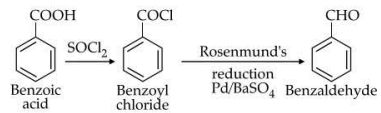 (ii) Propan-1-ol to 2-bromo propanoic acid -Firstly propanol is converted into propanoic acid by oxidizing in presence of alk. and then by using Red Phosphorous/ and Bromine gas is further converted into 2-Bromo-propanoic acid (iii) Ethanal or Acetaldehyde into But-2-en-1-al Aldol condensation (in presence of dil ) followed by dehydration.
© examsnet.com
Go to Question: